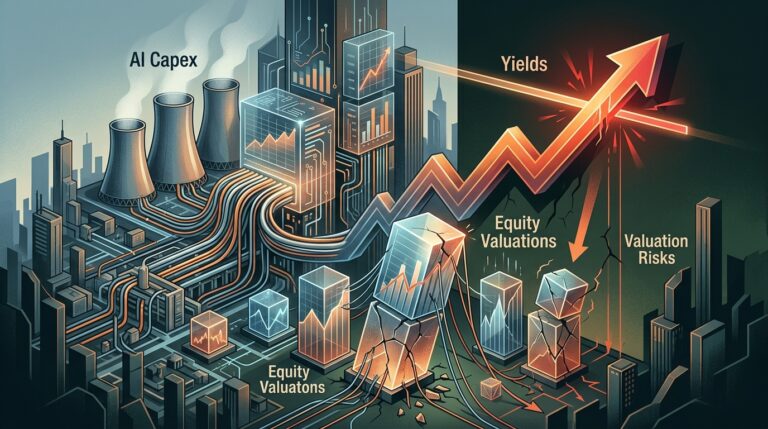
The technology sector is entering a period of unprecedented infrastructure spending just as macroeconomic borrowing costs test multi-year highs. For investors evaluating mega-cap technology stocks, the intersection of rising capital intensity and elevated risk-free rates introduces specific AI capex and equity valuation risks. Rather than focusing solely on top-line cloud growth, market participants are increasingly analyzing how massive capital expenditures might compress Return on Invested Capital (ROIC) and elevate equity hurdle rates.
The $1 Trillion AI Investment Scale
The baseline for this structural shift is the sheer volume of projected infrastructure spending. According to an August 2026 report by Joseph Briggs at Goldman Sachs Global Economics Research, global AI-related investment is forecast to reach $1 trillion in 2026, with $581 billion of that total concentrated in the United States (Goldman Sachs). This projection highlights a measurable trend toward higher capital intensity across the technology sector as companies build out physical data centers and hardware networks.
Simultaneously, the macroeconomic backdrop features elevated borrowing costs. Data from the Federal Reserve Bank of St. Louis confirms that the benchmark 10-Year Treasury Constant Maturity yield closed at 4.96% in mid-September 2026, hovering near the critical 5.0% threshold (FRED).
How Yields and Capex Impact Valuations
This combination of rising capital intensity and a near-5% risk-free rate creates a complex environment for corporate finance. In traditional equity valuation models, a 4.96% 10-year Treasury yield serves as the baseline for the risk-free rate, which directly increases a company’s Weighted Average Cost of Capital (WACC). When WACC rises, the hurdle rate for new investments also increases, meaning new projects must generate higher returns to justify their cost.
Furthermore, heavy infrastructure spending can pressure ROIC if the incremental returns from these investments lag the rising cost of capital. When companies shift toward capital-intensive infrastructure building, the denominator in the ROIC equation—invested capital—expands rapidly. If hyperscalers increasingly rely on external debt financing to fund this cycle, the resulting interest expenses and the accelerated depreciation of physical hardware could compress ROIC-WACC spreads. For more context on how these dynamics affect market multiples, see our previous analysis on Big Tech AI Debt Impact on Equity Valuation Multiples.
What Remains Unclear in Corporate Finance
The exact transmission of these macroeconomic factors into individual corporate balance sheets remains uncertain. Because specific debt-funding ratios and operating cash flow conversions vary widely among individual hyperscalers, it is not yet clear whether debt has structurally replaced internally funded capital expenditures across the entire sector.
Without audited company-level data confirming the exact mix of cash versus debt used to finance these specific data center build-outs, broad market assumptions about a sector-wide debt transition remain premature. Additionally, the exact depreciation schedules for next-generation AI hardware are still evolving, leaving a data gap in projecting long-term profit margins.
Next Watchpoints for Investors
The next critical watchpoint for investors assessing AI capex and equity valuation risks is the September 2026 Federal Open Market Committee (FOMC) meeting, which will provide updated guidance on the trajectory of the 10-year Treasury yield. Following that, the Q3 2026 earnings season will require close scrutiny of individual hyperscaler 10-Q filings to verify actual capital expenditures, debt issuance levels, and management commentary on ROIC expectations.
***
*Disclaimer: This article is for informational purposes only and does not constitute financial, investment, tax, or legal advice. Market conditions can change rapidly, and readers should consult with a licensed professional before making any investment decisions.*
Want the full institutional-style PDF version? Enter your email for the free PDF.