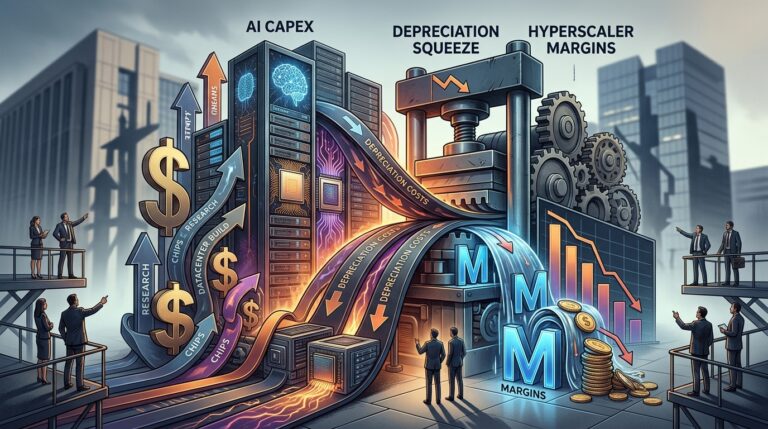
AI Capex Depreciation Now Squeezes Hyperscaler Margins
Q2 2026 earnings will not settle the AI spending debate with a single revenue number. The figure that matters more is depreciation and amortization (D&A) tied to AI capex, and it is about to show up in hyperscaler income statements at a scale most consensus models have not fully priced.
Investors heading into the Q2 2026 earnings season keep asking the same question: are the hundreds of billions of dollars that Microsoft, Alphabet, Amazon and Meta have poured into AI data centers actually translating into durable profit, or is AI capex quietly eating the margins it was supposed to expand? The honest answer, based on how capital spending flows through GAAP accounting, is that the two groups driving this year’s AI trade — chip and infrastructure “sellers” versus hyperscaler “spenders” — are entering earnings season on structurally different margin paths, and the mechanism behind that split is AI capex depreciation, not demand.
Why AI capex depreciation timing matters for hyperscaler margins
AI capex depreciation is not a new expense — it is old spending finally showing up on the income statement. When a hyperscaler builds a data center, the cash leaves the balance sheet as capital expenditure the moment construction happens, but the profit-and-loss hit is spread over the useful life of the servers, chips and buildings once those assets are placed into service. Data-center builds that broke ground in late 2024 and through 2025 are, by mid-2026, reaching the point where they get commissioned — switched on, capitalized, and started on their depreciation schedule. That timing lines up closely with the Q2 and Q3 2026 reporting periods now underway.
This accounting transmission channel is largely missing from headline AI capex coverage. References to a “$725 billion” 2026 capex figure for the largest hyperscalers and S&P 500 earnings-growth estimates near 23.6% year-over-year — both figures noted in the research brief behind this article — trace back to FactSet-tracked consensus commentary rather than a primary filing or release with a direct link available for this review. This article flags that gap explicitly rather than treating those two specific numbers as independently verified.
What is independently sourced, and what the rest of this analysis leans on, is more conservative. Bloomberg’s professional research desk has confirmed that the six largest U.S. hyperscalers are collectively on track to invest more than $500 billion in AI infrastructure, and that the current AI rally has so far been underpinned by actual cash-flow and earnings growth rather than pure multiple expansion (https://www.bloomberg.com/professional/blog/ai-bull-run-to-endure-in-2026-on-cash-flows-from-apps-etfs/). Separately, Bloomberg’s longer-horizon analysis puts Microsoft, Alphabet, Amazon, Meta and Oracle on a combined path toward $3 trillion to $4 trillion in AI-related capital spending through 2032 (https://www.bloomberg.com/professional/blog/ai-boom-built-on-shaky-geopolitical-footing/). That is the depreciation base that keeps growing for years, not just one quarter.
AI sellers versus AI spenders: two different margin paths
The “seller” side of the AI capex trade looks more straightforward. The Wall Street Journal’s chip-industry reporting shows that roughly half of semiconductor industry revenue in 2026 is expected to come specifically from AI chips sold into data centers (https://www.wsj.com/articles/ai-boom-buoys-chip-industry-even-as-risks-loom-large). That revenue is booked with margin recognized on delivery — it does not carry the multi-year depreciation drag on the seller’s own books that a data-center build creates for the buyer. The same WSJ reporting flags the risk on the other side of that trade: if AI monetization by the buyers takes longer than expected, the chip demand cycle itself is exposed (https://www.wsj.com/articles/ai-boom-buoys-chip-industry-even-as-risks-loom-large).
That risk is precisely the “spender” side of the hyperscaler margin story. Hyperscalers booking AI infrastructure spending as capex do not recognize it as an immediate cost or an immediate revenue driver. They absorb years of depreciation charges on the operating-income line, regardless of how fast associated cloud or AI-services revenue ramps. Even if cloud revenue growth stays strong — and Bloomberg’s research suggests the earnings support behind the AI trade has been real rather than purely speculative (https://www.bloomberg.com/professional/blog/ai-bull-run-to-endure-in-2026-on-cash-flows-from-apps-etfs/) — operating margin is a different line than revenue growth. A hyperscaler can post a strong top line and still show operating-margin compression if AI capex depreciation is growing faster than segment revenue in a given quarter. That is an analytical inference drawn from combining the cited capex figures with standard GAAP depreciation treatment; none of the cited sources themselves makes this specific margin projection.
The competing read on hyperscaler margins
Market participants who remain constructive on hyperscaler margins point to a different piece of the same evidence. If close to half of AI chip industry revenue is being absorbed into live data-center deployments in 2026, as the WSJ reporting indicates (https://www.wsj.com/articles/ai-boom-buoys-chip-industry-even-as-risks-loom-large), that implies real utilization rather than idle capacity sitting on hyperscaler balance sheets. Under this view, rising depreciation is simply the cost of an asset base being used productively, and cloud and AI-services revenue growth should eventually outrun the depreciation curve as workloads scale. This is a legitimate counter-read of the same underlying data, and it is the reason this earnings season is genuinely uncertain rather than a foregone conclusion in either direction.
Base case and risk case for hyperscaler margins in Q2–Q3 2026
Base case (a scenario, not a prediction): If hyperscaler cloud and AI-services revenue continues growing at a double-digit pace while newly commissioned data-center assets begin their depreciation schedules in the same reporting window, segment operating margin could compress even without any slowdown in customer demand. In that scenario, headline revenue beats could coexist with margin misses or cautious forward guidance — a combination that would look confusing on the surface but is consistent with the AI capex depreciation mechanics described above.
Risk case (a scenario, not a prediction): If hyperscalers keep accelerating capex commitments toward the $3 trillion–$4 trillion multi-year path Bloomberg has outlined (https://www.bloomberg.com/professional/blog/ai-boom-built-on-shaky-geopolitical-footing/) while monetization takes longer than current guidance implies — the exact risk the WSJ flags for chip demand more broadly (https://www.wsj.com/articles/ai-boom-buoys-chip-industry-even-as-risks-loom-large) — margin compression could extend beyond a single quarter into a multi-quarter theme rather than a one-time accounting bump.
Neither path is a house forecast. Both are conditional frames built from the sourced figures above, meant to help readers interpret whatever hyperscalers actually report, not to predict what they will report.
What Q2 2026 filings can and cannot confirm yet
As of this writing, hyperscaler Q2 2026 results and the associated 10-Q depreciation disclosures have not yet been published, so no specific company’s actual D&A dollar figure for the quarter can be cited here. It is also not yet known, from the sources reviewed, how each hyperscaler’s disclosed useful-life assumptions for servers and data-center equipment will interact with the specific assets commissioned in this window — that detail lives in each company’s own filings and will only be confirmed once those are released. Similarly, the $725 billion 2026 capex estimate and the 23.6% S&P 500 earnings-growth consensus figure referenced in early market commentary should be treated as claims attributed to aggregated data services rather than independently verified facts in this review, since no direct primary link was available to confirm them.
Reader watchpoint on AI capex depreciation and margins
The next concrete checkpoints are the Q2 2026 earnings calls and accompanying 10-Q filings from Microsoft, Alphabet, Amazon and Meta, expected over the final two weeks of July into early August 2026. Readers tracking this question should watch three specific line items rather than headline EPS: reported operating margin by cloud/AI segment, the year-over-year growth rate of depreciation and amortization expense relative to segment revenue growth, and any forward capex guidance changes on the earnings calls. A widening gap between revenue growth and operating-margin growth in those filings would support the AI capex depreciation squeeze described here; a narrowing gap would support the demand-offset counter-read instead.
—
*This article is informational market analysis produced by MarketPilotDaily and is not financial, investment, legal or tax advice. It does not recommend buying, selling or holding any security. Figures and scenarios above are drawn from the cited sources and standard GAAP accounting principles, are subject to change once companies report actual Q2 2026 results, and should not be relied upon as a prediction of any company’s future earnings, margins or stock performance. Readers should consult a licensed financial, legal or tax professional before making investment decisions.*
Get This Report as a PDF
Enter your email to receive the full analysis report as a PDF.