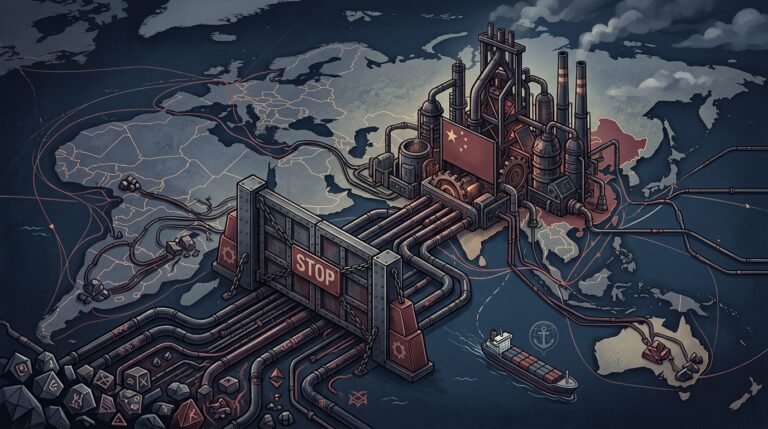
The narrative surrounding China’s export restrictions on gallium, germanium, and antimony often frames the situation as a binary embargo that has largely been resolved through diplomatic waivers. This surface-level reading misses a deeper structural shift. Beijing’s critical mineral policy has evolved into an asymmetric regulatory toll on Western high-tech manufacturing. By controlling the downstream chemical processing rather than just the raw extraction, Chinese regulators are forcing Western commercial fabricators to absorb persistent intermediary price premiums. Simultaneously, this dynamic drives a costly bifurcation in defense procurement as Western contractors scramble to build non-Chinese processing capacity ahead of upcoming statutory deadlines.
The Downstream Chemical Processing Choke Point
Western structural dependencies on critical minerals extend far beyond the mine. According to a September 2026 analysis by the Council on Foreign Relations, supply bottlenecks persist heavily in downstream processing and chemical separation, confirming that commercial supply chains depend on Chinese chemical processing even when the raw ores originate elsewhere (Council on Foreign Relations).
This means that securing alternative raw material sources does not bypass the primary choke point. The physical volumes of these minerals continue moving through third-party intermediaries, but they do so at steep compliance markups and extended delivery cycles. The market focus on headline export bans frequently overlooks these transshipment premiums and the reality that Western industry remains tethered to Chinese refining infrastructure.
MOFCOM’s Regulatory Wedge: Article 1 vs. Article 2
The legal architecture of these export controls reveals a deliberate splitting of the market. Recent regulatory adjustments have provided temporary relief for commercial users while permanently locking out defense applications. Specifically, China’s Ministry of Commerce (MOFCOM) Announcement No. 72 of 2025 suspended the dual-use export restrictions previously established under Article 2 of Announcement No. 46 of 2024. This suspension runs through November 27, 2026, detailing specific compliance mandates for commercial buyers (CIRS Group).
Here is where the market miscalculates the risk. While Article 2’s suspension eases commercial trade, Article 1’s strict ban on foreign military end-users remains fully in force. This creates a bifurcated industrial base: a low-margin commercial tier that can still access Chinese refining through complex compliance channels, and an expensive, supply-constrained defense procurement ecosystem that is entirely locked out.
The Cost of Supply Chain Bifurcation
For defense contractors, the permanent military end-use prohibition means that intermediate smelting and chemical separation must be entirely decoupled from Chinese infrastructure. This is not a temporary disruption but an irreversible structural change. Companies are forced to build or secure non-Chinese processing capacity to meet strict domestic sourcing mandates.
The uncertainty lies in how quickly Western refining infrastructure can scale to meet this specialized demand without the economies of scale previously provided by Chinese facilities. Until that capacity comes online, defense supply chains will likely face sustained margin pressure and procurement delays.
Strategic Watchpoints for the Industrial Base
The next phase of this supply chain realignment hinges on specific regulatory expirations and capacity milestones.
- November 27, 2026: This is the expiration date for the commercial dual-use export restriction suspension under MOFCOM Announcement No. 72. Market participants must monitor whether Beijing extends this waiver or allows it to lapse, which would immediately subject commercial buyers to the same bottlenecks currently facing defense contractors.
- Refining Capacity Announcements: Track capital expenditures and facility completions for downstream chemical separation outside of China. Raw ore extraction announcements alone do not resolve the processing deficit.
Disclaimer: This article is for informational purposes only and does not constitute financial, legal, or tax advice. This article was researched and drafted with AI assistance. Readers should consult licensed professionals before making investment or procurement decisions.
Want the full institutional-style PDF version? Enter your email for the free PDF.