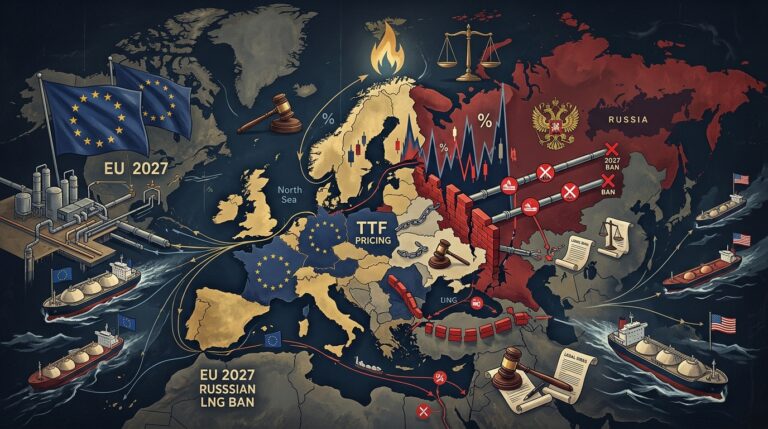
Europe is approaching a hard statutory deadline that fundamentally alters its natural gas architecture. Under Regulation (EU) 2026/261, the bloc’s prohibition on long-term Russian liquefied natural gas (LNG) imports takes effect on January 1, 2027. This follows the earlier short-term contract ban implemented on April 25, 2026.
While often framed as a simple physical embargo, the regulatory cutoff intersects with a fragile physical buffer. According to the European Union Agency for the Cooperation of Energy Regulators (ACER), European underground gas storage entered the 2026 refill season at just 28% capacity. By late October 2026, storage levels had only reached 75%, driving injection expenses to an estimated €27 billion and pushing Dutch TTF wholesale hub prices toward €90/MWh (ACER report).
The Article 248 Trap for European Utilities
The impending ban forces European utilities into a severe legal bind regarding legacy take-or-pay contracts signed before June 17, 2025. The official European Commission FAQ confirms that these long-term agreements cannot be executed for domestic import after the January 1, 2027 deadline.
Halting payments or refusing deliveries triggers immediate bilateral arbitration risks. European offtakers face a high threshold for claiming force majeure or hardship under civil law when dealing with Russian counterparties. Furthermore, Russian commercial courts can deploy anti-suit injunctions under Article 248 of the Russian Commercial Procedural Code, exposing European assets to forfeiture or severe penalties within Russian jurisdictions (Freshfields analysis).
Simultaneously, utilities face massive domestic compliance risks. Violating the EU’s prior authorization procedures under Article 5 of Regulation (EU) 2026/261 carries penalty thresholds set at a minimum of 3.5% of annual turnover or 300% of the transaction value. This dual exposure leaves energy firms caught between EU regulatory fines and Russian asset judgments.
Maritime Exemptions and Fleet Rerouting
The 2027 cutoff does not entirely remove Russian LNG from the global market or even from European corporate ledgers. EU sanctions include specific exemptions that permit European shipping operators to continue purchasing, transporting, and trading Russian Yamal LNG to non-EU destinations after January 1, 2027 (High North News).
This carve-out institutionalizes a complex maritime arbitrage loop. Because the European Commission guidance restricts domestic transshipment but allows third-country transfers, European-flagged vessels will likely reroute these cargoes to Asian buyers. Rerouting specialized ice-class carriers on extended voyages absorbs significant global fleet capacity. The net effect stretches maritime logistics, reducing the availability of vessels needed to bring replacement supplies into Europe.
Pricing Implications for the TTF Benchmark
With domestic offloading of Russian LNG banned and European vessels busy transporting those same molecules to Asia, the continent faces a structural supply deficit. To replace the lost domestic volumes, European utilities must bid aggressively for marginal spot cargoes.
This bidding war occurs against a backdrop of chronically thin storage cushions. The €27 billion spent to reach just 75% storage capacity by late October 2026 highlights the premium required to attract replacement gas (ACER report). As European buyers compete directly with Asian importers for non-Russian LNG, the Dutch TTF hub price—already testing €90/MWh—embeds a permanent risk premium reflecting both the longer shipping distances and the legal friction costs borne by the utilities.
Key Watchpoints for Winter 2026-2027
Market participants tracking European industrial energy costs and utility equities should monitor several concrete indicators as the January 2027 deadline approaches.
- Arbitration Filings: Watch for initial force majeure declarations by European utilities and subsequent Article 248 injunctions filed in Russian commercial courts (Freshfields analysis).
- Storage Withdrawal Rates: The pace at which the 75% storage buffer is depleted through November and December 2026 will dictate the urgency of spot market purchases (ACER report).
- Vessel Utilization: Tracking the routing of European-operated LNG carriers will indicate how much fleet capacity is absorbed by third-country exemptions (High North News).
Disclaimer: This article is for informational purposes only and does not constitute financial, legal, or tax advice. This article was researched and drafted with AI assistance. Market conditions and regulatory frameworks are subject to change. Readers should consult licensed professionals before making investment or legal decisions.
Want the full institutional-style PDF version? Enter your email for the free PDF.