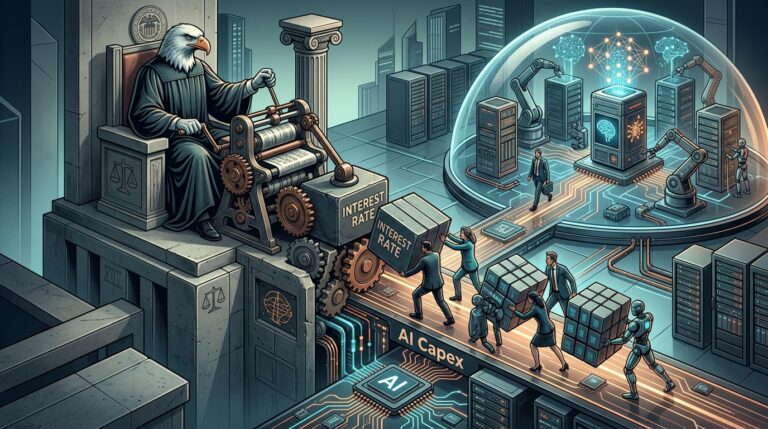
Big Tech’s record-breaking AI capital expenditure now faces a new, formidable obstacle: a higher cost of capital. The Federal Reserve’s decision to maintain a hawkish stance on interest rates directly increases the financial return required from these multi-billion dollar infrastructure projects, fundamentally altering the investment math for AI-driven equities.
The Fed’s Hawkish Hold
On July 29, 2026, the Federal Open Market Committee (FOMC) announced it would maintain the target range for the federal funds rate at 3.50% to 3.75% (https://www.federalreserve.gov/newsevents/pressreleases/monetary20260729a.htm). The decision was not unanimous; three members dissented, favoring an immediate 25 basis point rate hike. This hawkish dissent, combined with the Fed’s move away from explicit forward guidance, signals to markets that borrowing costs are likely to remain elevated (https://global.morningstar.com/en-nd/economy/us-fed-holds-steady-july-giving-few-hints-whats-come).
This policy decision occurs as Q2 2026 earnings season is in full swing, with a primary focus on the technology sector’s massive capital expenditures on AI infrastructure (https://www.zacks.com/stock/news/2963511/q2-earnings-season-in-full-swing). Market analysis has centered on these AI capex trends as a key driver for future growth (https://www.ig.com/uk/trading-strategies/big-tech-q2-2026-earnings—the-ai-capex-question-and-what-uk-in-260716).
Analysis: Why Higher Rates Change the AI Capex Equation
This is where the two narratives collide. A higher federal funds rate, confirmed by the Fed’s H.15 statistical release (https://www.federalreserve.gov/releases/h15/), directly increases the risk-free rate used to calculate the Weighted Average Cost of Capital (WACC) for corporations. A higher WACC acts as a higher “hurdle rate,” meaning new projects must promise a greater return on investment to be financially viable. For the long-duration, debt-heavy financing structures often used for data centers and chip fabrication, this change is not trivial. The expected future cash flows from AI must now be significantly larger or arrive sooner to justify the upfront spending.
In response to the Fed’s hawkish hold, several Wall Street analysts have already adjusted their monetary policy projections, anticipating a more prolonged period of tight credit (https://economictimes.indiatimes.com/markets/us-stocks/news/us-stock-market-jp-morgan-brings-forward-fed-rate-hike-call-to-december-after-july-policy-meeting/articleshow/132734118.cms?from=mdr). This shift has immediate implications for both equity and Treasury markets, which are recalibrating valuations based on the new cost of money (https://www.japantimes.co.jp/business/2026/07/30/markets/fed-hawkish-hold-stocks-bonds/).
What Remains Uncertain
The precise return-on-investment timeline for the current wave of AI capex remains a significant unknown. While companies project substantial future earnings, the path to profitability is not guaranteed and is now measured against a stricter financial benchmark. Furthermore, the exact mix of cash-on-hand versus new debt financing for these projects is not always transparent, making it difficult to assess the immediate impact of higher interest rates on each company’s balance sheet.
Next Watchpoint
For investors monitoring the impact of the Fed’s rate stance on AI capex, the next critical documents are the upcoming quarterly 10-Q filings from major technology firms. These filings should provide greater detail on capital expenditure financing and any revisions to long-term debt. Additionally, the release of the July FOMC meeting minutes will be essential for understanding the arguments behind the three hawkish dissents and gauging the committee’s future policy leanings.
*(Disclaimer: This article is for informational purposes only and does not constitute financial, legal, or tax advice. Readers should consult with a licensed professional before making any investment decisions.)*
Want the full institutional-style PDF version? Enter your email for the free PDF.