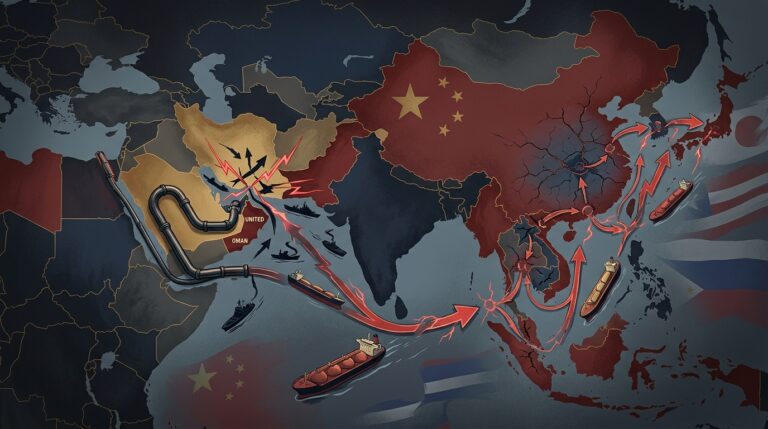
Following repeated geopolitical tensions in the Persian Gulf, market participants frequently look to overland pipeline infrastructure in Saudi Arabia and the United Arab Emirates as a structural failsafe against maritime chokepoint disruptions. However, a closer examination of operational throughput limits, non-crude commodity exposure, and insurance mechanics reveals a significant vulnerability gap.
While overland pipelines can divert a portion of crude oil away from the Strait of Hormuz, these bypasses cannot fully insulate Asian buyers or global markets from severe supply shocks. Effective terminal export capacity remains constrained, critical commodities like liquefied natural gas (LNG) and fertilizers have zero landward alternative, and surging war-risk insurance premiums continue to dictate commercial maritime transit.
The Math Behind the Overland Crude Buffer
The sheer volume of energy routed through the Strait of Hormuz dwarfs the operational spare capacity of regional pipeline alternatives. According to the U.S. Energy Information Administration (EIA), 20.9 million barrels per day (b/d) of crude and petroleum liquids transited the Strait in the first half of 2025. Of this crude and condensate volume, 89% was routed directly to Asian destinations, underscoring the concentrated geographic exposure of import-dependent economies.
Against this baseline, the theoretical relief provided by combined regional pipeline bypass capacity is approximately 4.7 mb/d. The International Energy Agency (IEA) documents that Saudi Arabia’s 1,200-kilometer East-West Petroline has a design capacity of 5.0 mb/d, with an untested expansion capability up to 7.0 mb/d. However, routine domestic West Coast off-take consumes approximately 2 mb/d, leaving an operational buffer of 3 to 5 mb/d. Similarly, the UAE’s Habshan-Fujairah ADCOP system has a capacity of 1.5 to 1.8 mb/d, but with 1.1 mb/d currently utilized, it offers only about 700 kb/d of spare capacity.
This structural mismatch means that even if all overland pipelines operate at maximum theoretical capacity, they can only offset roughly a quarter of the daily crude volumes dependent on the Strait of Hormuz.
Zero-Bypass Reality for LNG and Fertilizers
While crude oil markets have partial overland mitigation, the natural gas and petrochemical sectors face near-total maritime transit dependence. The IEA highlights that non-pipeline producers, specifically Qatar, Iraq, and Kuwait, lack alternative export routes and remain entirely reliant on open passage through the Gulf.
The economic impact of this zero-bypass reality is severe during periods of maritime disruption. Multilateral tracking by the United Nations confirms that recent disruptions in the Strait triggered acute trade contractions across strategic non-crude commodities. The data shows a 95% drop in LNG flows, alongside an 83% decline in urea shipments. Because the Strait of Hormuz supplies one-third of global seaborne urea volumes, this bottleneck directly transmits regional security shocks into global agricultural supply chains. Furthermore, the UN reported steep declines in methanol (80%) and ammonia (75%), underscoring the complete lack of overland optionality for petrochemicals.
The Compounding Cost of War-Risk Insurance
Beyond physical infrastructure limits, the commercial viability of maritime energy transit is heavily governed by insurance mechanics. When physical risks escalate, the financial friction of moving vessels through contested waters can effectively close a chokepoint even if the physical waterway remains navigable.
Investigative reporting by Caixin Global details how commercial maritime underwriters recently quadrupled Additional War Risk Premiums (AWRP) from 0.25% to 1.00% of a vessel’s hull replacement value per 7-day transit window. For modern energy carriers, this premium escalation translates into massive per-voyage cost increases, driving supertanker spot charter rates near $800,000 per day. These insurance hurdles impose prohibitive costs on crude and gas carriers, forcing Asian importers to absorb the premium or seek alternative, often more expensive, Atlantic Basin supplies.
Unresolved Red Sea Displacement Risks
A critical uncertainty in the pipeline bypass thesis is the geographic destination of the diverted crude. Saudi Arabia’s East-West Petroline terminates at the Yanbu marine terminal on the Red Sea coast. Diverting crude away from the Persian Gulf via Petroline does not eliminate maritime security risks; rather, it displaces the exposure into the Red Sea corridor.
If security threats simultaneously affect the Bab el-Mandeb Strait or the broader Red Sea, the Yanbu terminal’s utility as a safe export hub is compromised. The extent to which Asian buyers can reliably lift crude from Yanbu without incurring similar AWRP penalties or facing physical interdiction remains an untested variable in a dual-front disruption scenario.
Key Watchpoints for Energy Markets
For market observers and energy investors evaluating supply chain resilience, the focus must shift from theoretical pipeline nameplate capacities to operational and commercial bottlenecks. The next critical indicators include:
- Joint War Committee (JWC) Updates: Monitor the JWC’s listed areas and subsequent AWRP rate adjustments. A sustained premium above 1.00% of hull value will signal that insurers view the corridor as commercially unviable for standard spot charters.
- Asian LNG Storage and Substitution: Because Qatari LNG has zero pipeline bypass optionality, watch for shifts in Asian utility procurement strategies, specifically increased spot purchases from the U.S. Gulf Coast or Australia to offset Hormuz exposure.
- Yanbu Terminal Export Volumes: Track actual lifting data from the Yanbu marine terminal to verify if the 3 to 5 mb/d operational buffer is being utilized, and whether those cargoes are successfully navigating the Red Sea to reach Asian destinations.
*Disclaimer: This article is for informational purposes only and does not constitute financial, legal, or tax advice. This article was researched and drafted with AI assistance. Readers should consult a licensed professional before making any investment decisions.*
Want the full institutional-style PDF version? Enter your email for the free PDF.