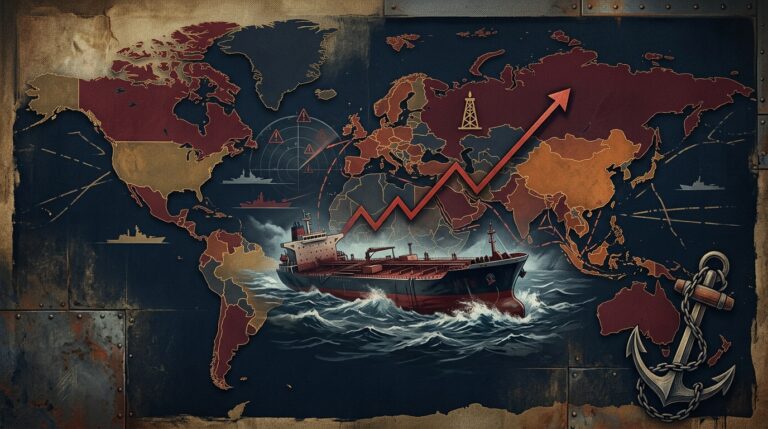
While strategic reserve releases push down paper oil futures, soaring war-risk insurance and shipping disruptions are creating a structural price shock in the physical delivery market.
Recent emergency stock releases by the International Energy Agency (IEA) have created a misleading signal of calm in global energy markets, pushing down benchmark futures prices (https://iea.blob.core.windows.net/assets/a25ddf53-cd6c-4910-ac90-16bfd28399e7/-12MAR2026_OilMarketReport.pdf). However, this paper-market stability masks a growing and severe disconnect with the real-world cost of transporting energy. For businesses and economies, the true landed cost of oil and gas is now being dictated less by commodity prices and more by unhedgeable risks in maritime chokepoints.
The Hard Facts of Transit Risk
Recent escalations in the Strait of Hormuz and the Red Sea have fundamentally repriced the risk of maritime transit. According to data from S&P Global Maritime and Marsh Risk, war-risk insurance premiums for vessels transiting the Persian Gulf have surged to between 7.5% and 10.0% of the ship’s total hull value as of July 2026 (https://gulfpetro.om/how-freight-war-risk-insurance-and-shipping-routes-shape-global-bitumen-trade-in-2026/). This is not a surcharge on cargo, but a direct, multi-million dollar cost just for a vessel to enter the region.
This friction is a key driver behind the World Bank’s recent downward revision of its global economic growth forecast to a 2.5%-3.0% range, citing energy volatility as a primary concern (https://www.worldbank.org/en/publication/global-economic-prospects). The situation reflects scenarios long documented by security analysts, where conflict-driven disruptions in critical chokepoints create cascading economic consequences (https://www.cfr.org/reports/conflict-driven-chokepoint-disruptions).
Analysis: Why Insurance Is the Real Bottleneck
This spike in insurance costs creates a structural disconnect between paper and physical markets. While an oil trader can hedge against a change in the price of Brent crude, there is no simple financial instrument to hedge against a P&I Club suddenly cancelling coverage or a war-risk premium increasing tenfold. This transforms a variable commodity cost into a fixed, and much higher, logistical barrier.
The result is a two-tiered market. One market is for paper barrels, influenced by strategic reserves. The other is for wet barrels physically delivered to a port, which carry a large, non-negotiable risk premium. This forces shippers to either pay the exorbitant insurance or take the much longer and costlier route around Africa, adding weeks and millions in fuel costs to voyages. This dynamic is a core reason why headline inflation may not fall as expected, even if benchmark oil prices appear stable.
Furthermore, this is not just an energy story. The same routes are critical for other industrial inputs. Data from the IEA’s 2026 Global Critical Minerals Outlook shows that 11 of 20 tracked strategic minerals are already subject to active export controls, compounding supply chain fragility (https://iea.blob.core.windows.net/assets/2831e0dc-f030-4d14-985c-d26d1af4430f/GlobalCriticalMineralsOutlook2026.pdf). The maritime disruption acts as a powerful multiplier on these existing industrial bottlenecks.
What Remains Uncertain
The key uncertainty is duration. It is not yet clear whether these historically high insurance premiums represent a temporary panic or a permanent repricing of Middle East transit risk. The capacity of the global shipping fleet to absorb the inefficiencies of mass rerouting around Africa over a prolonged period has not been tested at this scale. Finally, the potential for further military escalation, or a diplomatic breakthrough that reopens key routes under secure conditions, remains the largest unknown variable.
What to Watch Next
For market participants tracking this disconnect, the focus should shift from oil futures to logistical and insurance data. The next key indicator will be the upcoming quarterly update from the Lloyd’s Market Association (LMA) Joint War Committee, which defines the high-risk maritime zones and directly influences premiums. Additionally, the next monthly IEA Oil Market Report will be critical to see if physical delivery disruptions and rerouting are visibly drawing down global inventories faster than strategic releases can replenish them.
*Disclaimer: This article is for informational purposes only and does not constitute financial, legal, or tax advice. Readers should consult with a licensed professional before making any investment decisions.*
Want the full institutional-style PDF version? Enter your email for the free PDF.