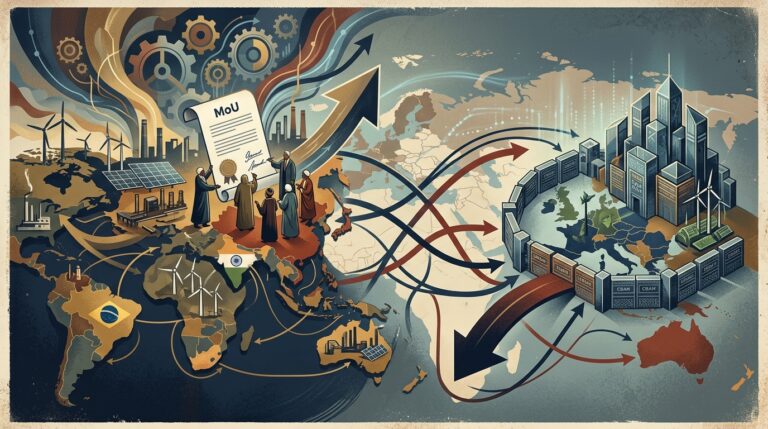
When leaders at the 18th BRICS Summit in New Delhi formalized their opposition to unilateral carbon border adjustments in September 2026, they framed the move as a defense of developing economies against Western protectionism. Backing the operational rollout of the Memorandum of Understanding (MoU) on the BRICS Carbon Markets Partnership, the bloc sought to present an alternative, South-South vision for climate trade policy. However, for industrial commodity exporters in India, Brazil, China, and South Africa, diplomatic consensus does not alter regulatory reality: the European Union’s Carbon Border Adjustment Mechanism (CBAM) entered its definitive financial regime on January 1, 2026, establishing immediate compliance obligations that diplomatic declarations cannot offset.
The core tension lies in the structural mismatch between political cooperation and regulatory interoperability. While BRICS members condemn unilateral carbon border tariffs for penalizing developing countries undergoing capital-intensive energy transitions, the definitive EU CBAM enforces mandatory carbon certificate surrenders on six covered industrial sectors. Because EU rules allow carbon cost deductions only under strictly certified mechanisms where an explicit carbon price was paid in the exporting nation, the nascent BRICS carbon market framework offers zero direct exemption from EU border liabilities in 2026.
The New Delhi Consensus vs. The Definitive CBAM Phase
Adopted during the September 12–13, 2026 summit in New Delhi, the BRICS declaration marked an escalated political critique of Western climate trade policy. Under Paragraph 108, member states formally opposed unilateral, punitive, discriminatory, and protectionist measures that run counter to international law, explicitly identifying mechanisms like the EU CBAM and the upcoming UK CBAM as instruments that undermine the adaptive capacity of developing nations. Under Paragraph 109, the summit supported the concrete execution of the MoU on the BRICS Carbon Markets Partnership, which was first conceived at the 2024 Kazan Summit and expanded in 2025.
Yet the partnership functions primarily as a platform for capacity building, technical information exchange, and policy coordination. It established a Dialogue on Aligning Carbon Markets with Adaptation Goals alongside the BRICS Laboratory for Trade, Climate Change and Sustainable Development. Crucially, it does not establish a unified, cross-border carbon pricing exchange, a common clearinghouse, or mutually fungible emissions units. As documented in institutional reviews of BRICS carbon market cooperation, national carbon systems among member states remain deeply heterogeneous, ranging from China’s national Emissions Trading Scheme (ETS) to India’s developing Carbon Credit Trading Scheme (CCTS), 2023, and voluntary frameworks elsewhere.
EU CBAM’s 2026 Definitive Regime Rules
In contrast to the voluntary coordination characterizing the BRICS initiative, the EU’s regulatory machinery is rigid, centralized, and financially binding. Having completed its transitional reporting period between 2023 and 2025, the European Commission initiated the CBAM definitive regime on January 1, 2026, under Regulation (EU) 2023/956.
Under these definitive operational rules, commercial importers exceeding a single mass-based threshold of 50 tonnes of covered goods—spanning iron and steel, aluminium, cement, fertilisers, hydrogen, and electricity—must secure the legal status of an Authorised CBAM Declarant to clear customs. Rather than merely submitting emissions reports, authorized declarants must purchase digital CBAM certificates. The price of these certificates is benchmarked directly to the quarterly average of EU ETS allowance auction prices throughout 2026, transitioning to a weekly average in 2027.
Physical surrender of certificates corresponding to embedded emissions across 2026 imports will occur in 2027. Failure to surrender adequate certificates incurs an automatic financial penalty of €100 per excess tonne of CO₂ equivalent, in addition to the requirement to surrender the missing certificates.
The Industrial Exposure Gap: Emerging Markets Under Pressure
The practical friction between EU regulations and BRICS exporters is demonstrated by direct industrial metrics, particularly in energy-intensive primary manufacturing like steel and aluminium. Emerging economies often feature higher embedded emissions due to reliance on fossil-fuel-dependent electrical grids and blast furnace production routes—a reality recognized at the New Delhi Summit, which affirmed the continuing necessity of fossil fuels in emerging market energy mixes alongside renewables, nuclear, and hydrogen.
This reliance generates substantial cost disparities at the border, as outlined in the comparative metrics below:
| Metric / Regulatory Variable | EU CBAM Compliance Standard (2026) | BRICS Emerging Market Baseline (India Example) |
|---|---|---|
| Operational Status | Definitive regime active (financial certificate purchases) | Domestic schemes under rollout (e.g., India CCTS, 2023) |
| Average Crude Steel Carbon Intensity | ~1.90 tonnes CO₂ / tonne steel (Global benchmark) | 2.54 tonnes CO₂ / tonne steel |
| ETS Allowance / Compliance Price | Auction average indexed above €75 / tonne CO₂ (Early 2026) | Heterogeneous; credits not mutually fungible with EU ETS |
| Theoretical Gross Border Exposure (Steel) | Direct certificate surrender per verified embedded tonne | ~€190 / tonne steel before domestic deductions or free-allocation baselines |
| Eligible Offset / Deduction Mechanism | Article 9: Explicit carbon price paid in origin country | Voluntary carbon credits or unaccredited domestic offsets not deductible |
As the table demonstrates, unadjusted primary steel exports from high-carbon production routes face steep certificate surrender requirements. Under Article 9 of the EU regulation, an authorized declarant can claim a reduction in the number of CBAM certificates surrendered solely by providing verified documentation that an explicit carbon price was paid in the country of origin. Because the BRICS Carbon Markets Partnership does not establish an internationally harmonized explicit carbon levy, exports from member states cannot bypass European borders through bloc-level political alignment alone.
Structural Barriers to Mutual Recognition
Why cannot a BRICS-wide carbon offset or credit fulfill EU CBAM liabilities? The primary obstacle is the legal architecture of both the EU ETS and multilateral climate agreements. The EU CBAM was engineered to prevent carbon leakage while ensuring compliance with World Trade Organization non-discrimination principles by mirroring domestic ETS rules. The EU ETS relies on an explicit cap-and-trade allowance mechanism; it does not permit general voluntary carbon offsets or third-party carbon credits to dilute its industrial compliance cap.
Furthermore, the BRICS bloc has not established interoperability under Article 6.4 of the Paris Agreement, which governs international crediting standards. Without a unified emissions registry, verified measurement, reporting, and verification (MRV) protocols recognized by European verifiers, and explicit border accounting adjustments, BRICS-originated credits have no legal standing within the EU’s Authorised Declarant registry. While the New Delhi consensus aims to coordinate adaptation financing and institutional knowledge, it leaves intact the individual exposure of trade-exposed manufacturing sectors.
The regulatory pressure will compound in the near term. Importers of covered goods are not only managing definitive European certificate costs throughout 2026, but are also preparing for the United Kingdom’s CBAM, scheduled to take effect on January 1, 2027. This dual-border regime restricts the capacity of industrial exporters to deflect higher-carbon goods between European economies.
What to Watch Next
Industrial trading desks, compliance teams, and trade policy monitors should track several concrete milestones over the coming months to assess whether the BRICS partnership shifts from diplomatic alignment to structural trade integration:
- Technical Working Group Guidance: Publication of definitive implementation rules or registry frameworks from the BRICS Laboratory for Trade, Climate Change and Sustainable Development regarding bilateral credit recognition among member states.
- Article 9 Verification Precedents: The first public European Commission decisions regarding third-country carbon tax deductions under CBAM Article 9, specifically evaluating how national pricing mechanisms like India’s CCTS or China’s national ETS are credited.
- Authorised Declarant Application Volume: Registry processing rates and customs audits across EU ports of entry through Q3 and Q4 2026 to evaluate compliance friction for bulk commodity shipments.
- UK CBAM Harmonization: The final publication of secondary legislation and sectoral methodologies for the UK CBAM ahead of its January 1, 2027 launch date.
Disclaimer: This article is provided for educational and informational purposes only and does not constitute legal, tax, regulatory, or financial advice. This article was researched and drafted with AI assistance. Regulatory interpretations and cross-border trade policies are subject to ongoing administrative updates. Organizations should consult licensed trade and regulatory counsel regarding specific compliance requirements.
Related MarketPilotDaily coverage: Browse the Global Affairs archive.