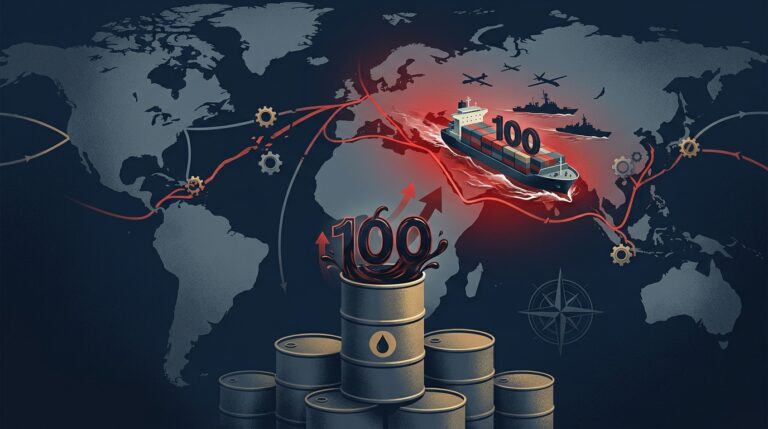
Brent crude futures have crossed the $100 per barrel threshold, a move widely attributed to the Houthi blockade of Saudi-linked shipping in the Bab-el-Mandeb strait (https://www.theguardian.com/business/2026/jul/23/bab-al-mandab-blockade-push-oil-100-houthi-ships). However, this price spike is not a simple story of production cuts or supply shortfalls. The real driver is a severe and complex crisis in maritime logistics, where physical pipeline limits, tanker rerouting mechanics, and a fractured insurance market are adding immense friction and cost to global energy delivery.
The New Facts on the Water
On July 20, 2026, Houthi forces declared a ban on all vessels linked to Saudi Arabia transiting the Bab-el-Mandeb, a critical chokepoint for global trade (https://www.lloydslistintelligence.com/resources/blog/red-sea-brief-23-july-2026). The market reaction was immediate. Data shows Saudi crude exports through the strait fell to nearly zero in the following week (https://www.thenationalnews.com/business/energy/2026/07/26/saudi-arabia-shifts-to-suez-as-houthis-drive-bab-al-mandeb-oil-exports-to-near-zero/). Correspondingly, northbound crude transits through the Suez Canal surged by 106% to 1.06 million barrels per day (mbd) as tankers were rerouted north (https://www.thenationalnews.com/business/energy/2026/07/26/saudi-arabia-shifts-to-suez-as-houthis-drive-bab-al-mandeb-oil-exports-to-near-zero/).
This disruption has been compounded by reports that Houthi authorities, in consultation with Iran, are now considering a transit fee regime for all other commercial vessels, while explicitly exempting Chinese-operated tankers (https://newsukraine.rbc.ua/news/houthis-want-tankers-to-pay-for-red-sea-transit-1785331431.html, https://investinglive.com/news/yemen-s-houthis-are-considering-fees-for-ships-sailing-through-the-red-sea-reuters/).
Analysis: The Three Frictions in the Red Sea Oil Trade
This is more than a geopolitical headline; it’s a structural breakdown of energy logistics. Three distinct points of friction explain why costs are soaring beyond the simple supply-demand equation.
1. The Crude ‘Workaround’ Is a Bottleneck, Not a Solution
Saudi Arabia’s primary alternative route for its crude is the East-West Petroline, a pipeline with a capacity of up to 7 mbd connecting its eastern fields to the Red Sea port of Yanbu (https://www.aa.com.tr/en/energy/energy-projects/red-sea-tensions-expose-vulnerability-of-alternative-oil-export-routes/58638, https://www.meforum.org/mef-observer/the-promise-and-perils-of-saudi-arabias-red-sea-port-of-yanbu). From Yanbu, crude can be shipped north through the Suez Canal. However, Very Large Crude Carriers (VLCCs), the workhorses of the global oil trade, are too large to pass through the Suez fully laden. They must first offload a portion of their cargo at the Ain Sukhna terminal, which is then piped across Egypt via the 2.5 mbd SUMED pipeline to the Mediterranean port of Sidi Kerir, where it is reloaded (https://www.kpler.com/blog/explainer-can-saudi-arabia-keep-its-red-sea-oil-exports-flowing-without-bab-el-mandeb, https://gcaptain.com/asia-bound-tanker-exits-red-sea-via-suez-as-others-risk-strait/). This ship-to-pipeline-to-ship process is a costly and time-consuming workaround that creates significant logistical delays and ties up the available tanker fleet (https://www.morningstar.com/news/marketwatch/20260729114/saudi-arabia-has-a-new-and-pricier-workaround-to-export-its-oil).
2. Refined Products Have No Pipeline Escape Route
A critical distinction missed in most coverage is that the SUMED pipeline is for *crude oil only* (https://www.argusmedia.com/en/news-and-insights/latest-market-news/2857746-saudi-product-cargoes-reroute-via-suez-on-houthi-risks). Refined products like gasoline, diesel, and jet fuel produced at Saudi Red Sea refineries have no such pipeline alternative. These cargoes must either transit the Suez Canal or take the far longer and more expensive route around Africa’s Cape of Good Hope. This adds approximately 30 days to a typical voyage to Asia, dramatically increasing freight costs and tightening the market for these specific fuels (https://www.spartacommodities.com/market-outlook/yanbu-rerouting-options-and-asian-refining-limitations/). Data already shows a 33% drop in light-end product transits through Bab-el-Mandeb, a flow that was 95% Saudi-origin in June (https://www.vortexa.com/insights/red-sea-light-ends-transiting-bem-fall).
3. A Two-Tiered Market for Insurance and Freight
The blockade has caused maritime war risk insurance premiums to spike for any vessel with perceived links to Saudi Arabia (https://www.yemenmonitor.com/en/Details/ArtMID/908/ArticleID/177707). More importantly, the proposed transit fee system with exemptions for Chinese vessels threatens to create a two-tiered global shipping market. Non-exempt vessels will face a choice: pay the fee, risk attack, or divert around Africa. This bifurcation of risk and cost fundamentally alters the competitive landscape for oil traders and refiners, particularly those in Asia who rely heavily on Middle Eastern crude (https://www.theguardian.com/world/2026/jul/28/asia-energy-oil-crisis-red-sea-blockade-houthis).
What Remains Uncertain
While the direction of costs is clear, several key variables remain unknown. The exact details of the Houthi transit fee—including the price, enforcement mechanism, and the full list of exempted nations—have not been officially announced. The long-term operational strain on the SUMED pipeline and its terminals from sustained high-volume use is also untested. Finally, the potential for a coordinated international naval response to secure the strait remains a significant, but unpredictable, factor.
Next Watchpoints
For market participants tracking this evolving situation, the next key data points will be the weekly maritime war risk insurance premium updates from Lloyd’s for the Red Sea High-Risk Area. Additionally, forthcoming tanker tracking reports from data providers like Kpler and Vortexa will be crucial for quantifying the volume of Saudi refined products being diverted around the Cape of Good Hope. Any official statement from Houthi authorities formalizing the transit fee regime would serve as the next major market catalyst.
*(Disclaimer: This article is for informational purposes only and does not constitute financial, legal, or tax advice. Readers should consult with a licensed professional before making any investment decisions.)*
Want the full institutional-style PDF version? Enter your email for the free PDF.