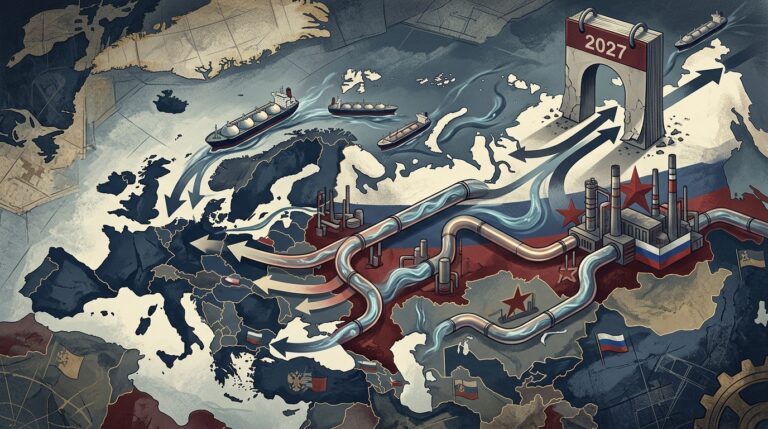
Russian LNG Imports to EU Surge Ahead of 2027 Ban
Dek: A regulation designed to end Russian gas purchases has, in its transition phase, coincided with a short-term rise in Russian LNG deliveries to France and other EU hubs. The mechanism is legal, dated, and traceable to the phased structure of the rule itself.
Russian LNG imports into the European Union rose in the first half of 2026, even as Brussels enforces a regulation meant to end them. That is the direct answer to what investors and energy-market watchers are asking this month: the EU has not reversed course on Russian gas. It has instead entered a transition window that legally permits — and in practice encourages — a front-loading of deliveries before firmer restrictions take hold in 2027.
What actually changed: the stage tag
The Council of the European Union has formally adopted REPowerEU Regulation (EU/261/2026), which establishes a stepwise ban on Russian gas and LNG imports rather than an immediate cutoff. The regulation is enacted law, not a proposal — that distinction matters, because it means the phased dates inside it are binding schedule items, not political aspirations.
The key phasing point for this question: long-term LNG contracts are set to be banned starting January 1, 2027, while transshipment through European hubs remains legally permitted through the end of 2026. That is the structural hinge this article turns on.
The fact block: what the shipping and trade data show
Three data points frame the size of the current transition, each from a distinct dataset and timeframe.
France recorded a 34% month-on-month increase in Russian LNG imports in June 2026, according to a Centre for Research on Energy and Clean Air (CREA) report covering that month. That same report describes Russian LNG flows to Europe overall as broadly stable rather than declining over the period it covers.
Separately, shipping-tracking data compiled by Times Now World shows EU imports of Russian LNG from the Yamal project rose 17.9% year-on-year between January and May 2026. That figure covers a five-month window and one specific export project, so it should not be read as an EU-wide annual growth rate — it is evidence of directional momentum at one major supply source, not a full-bloc total.
For scale, UN Comtrade recorded the EU’s direct imports from Russia at $30.74 billion for the year ending December 31, 2025 (https://comtradeplus.un.org). That baseline predates REPowerEU Regulation (EU/261/2026)’s formal adoption and therefore captures the exposure level the phased ban is now working to unwind, not the effect of the ban itself.
Why the numbers and the law aren’t actually contradicting each other
Here’s the part that gets lost in headlines calling this a policy failure: the regulation itself created the incentive to import more, not less, in the near term.
Under EU/261/2026’s phased structure, buyers holding long-term LNG contracts have a fixed, legally defined window — now through the end of 2026 — during which those contracts can still be executed before the January 1, 2027 long-term ban takes effect. A utility sitting on a long-term contract has a rational, contract-driven reason to draw down remaining volumes before that door closes, rather than leave gas on the table.
The transshipment channel adds a second, separate pressure point. Because EU hubs can still legally re-route or blend Russian-origin LNG through the end of 2026, some of the volume showing up in national import statistics — including France’s June increase — reflects hub activity that is scheduled to lose its legal basis at year-end, not a change in EU policy direction.
Market participants describe this pattern as a “stockpiling window” ahead of the 2027 cliff, though MarketPilotDaily has not identified an official EU document that uses that specific framing; it remains a market interpretation rather than a regulatory description.
Economic implications: what the transition means for gas costs and market exposure
The $30.74 billion 2025 baseline (https://comtradeplus.un.org) represents the scale of Russian-origin gas exposure that EU/261/2026 is designed to eliminate over the phase-out period. A front-loaded import pattern in 2026 — visible in France’s 34% monthly jump and the Yamal project’s 17.9% year-on-year rise through May — has two distinct market implications worth separating.
Short-term catalyst: Front-loaded Russian LNG deliveries add to European storage ahead of winter, which is one factor among several that can influence near-term European gas price behavior. This is a supply-timing effect tied to the contract-expiry calendar, not a demand or macro shift.
Longer-term structural question: Once the long-term contract ban takes effect January 1, 2027, the volumes currently being front-loaded cannot simply be replaced on the same contractual terms. Whether US, Qatari, or other non-Russian LNG suppliers can fill that gap at comparable cost is a separate question this dataset does not answer — the source pack used here contains no forward pricing or replacement-supply cost data, so any statement about future European gas prices beyond this point would be speculation, not analysis grounded in the cited sources.
Readers should treat any claim that European utility costs or LNG-shipping company revenues will move in a specific direction after January 2027 as an open question, not a forecast this article can support with the evidence in hand.
What this is not: separating claim from fact
It is a fact, tied to official EU regulatory text, that the long-term LNG ban takes effect January 1, 2027 and that transshipment permissions run through the end of 2026.
It is a claim, made by market commentators rather than by the EU itself, that this represents importers deliberately “racing” the deadline — the underlying data is consistent with that read, but no official EU source in this source pack characterizes the increase that way.
It is analysis, not fact, to connect the phased contract structure to the observed import increase — this article’s central interpretation is that the legal architecture of EU/261/2026 created the incentive, based on the dated provisions in the regulation and the timing of the France and Yamal figures cited above.
Any statement about what happens to Russian LNG volumes after January 1, 2027 is a scenario: if no substitute long-term contracts are signed with non-Russian suppliers before then, EU buyers currently reliant on Russian long-term volumes would need to source replacement supply through spot markets or new contracts — but this source pack contains no data confirming whether such substitute arrangements are already underway.
Who is affected and what to watch
European utilities and industrial gas buyers with existing long-term Russian LNG contracts face a hard compliance deadline of January 1, 2027, after which those contracts cannot legally continue under EU/261/2026. LNG shipping and hub-operating companies active in France and other transshipment points are affected by the narrower, end-of-2026 deadline on re-routing permissions. Investors tracking European energy names should note that these two deadlines are not the same date and do not carry the same legal consequence — conflating them risks mis-timing any assessment of exposure.
Uncertainty block
Several things this dataset does not resolve: the source pack does not specify what share of the France and Yamal volume increases is attributable to long-term contract front-loading versus transshipment activity versus other factors; it does not include post-2027 replacement-supply contracts, if any exist; and it does not include forward European gas price data. Readers should treat the “front-loading” explanation in this article as the best-supported interpretation available from the cited sources, not a confirmed causal finding — CREA’s report describes volume changes, not buyer motivations, and no source in this pack quotes an importer directly explaining its purchasing rationale.
Next watchpoint
The next concrete checkpoint is January 1, 2027, when the long-term LNG contract ban under REPowerEU Regulation (EU/261/2026) takes legal effect. A second, earlier checkpoint is December 31, 2026, when the transshipment permission expires — the next CREA monthly tracker and Eurostat trade release covering that transition period will show whether the France-style import surge continues, plateaus, or reverses as that deadline approaches.
—
*This article is for informational purposes only and does not constitute financial, legal, or tax advice. It does not recommend buying, selling, or holding any security, commodity, or asset, and it does not predict future prices, returns, or regulatory outcomes. Readers should consult a licensed financial, legal, or tax professional before making decisions related to the matters discussed here.*
Get This Report as a PDF
Enter your email to receive the full analysis report as a PDF.