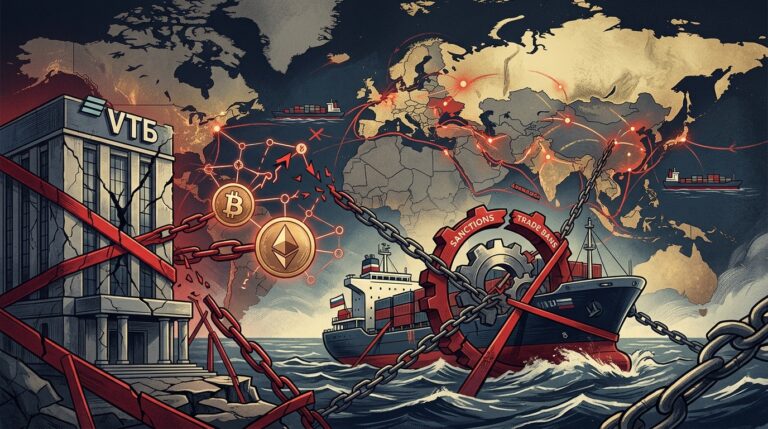
The Rising Cost of Non-Dollar Trade
Cross-border compliance is becoming more expensive for multinational companies and regional trade financiers exposed to Russia-linked settlement routes. Western regulatory pressure is not simply cutting off non-dollar commerce. It is making access to payment channels more conditional, less liquid, and more dependent on intermediaries willing to absorb sanctions and compliance risk.
As secondary sanctions reshape China-Russia trade payments, alternative clearing channels are proving less like a clean escape from Western financial infrastructure and more like a narrower, costlier operating layer. Payments routed through third-country intermediaries can face longer clearing times, higher counterparty risk, and more complex compliance screening.
U.S. and EU Pressure on Alternative Clearing
On September 14, 2026, the U.S. Department of the Treasury designated Russian state-owned VTB Bank under Operation Economic Outcast and E.O. 13902 for facilitating transactions connected to Iran’s financial sector (U.S. Treasury). The action also warned foreign financial institutions about secondary sanctions risk tied to correspondent relationships with designated entities.
European measures are also reaching beyond conventional bank rails. The European Union’s 21st sanctions package, adopted in July 2026, extended transaction prohibitions to 14 crypto-related platforms across third-country jurisdictions and designated four entities tied to the cross-border A7 network, according to TRM Labs analysis (TRM Labs). Because TRM Labs is a specialist analysis source rather than the legal text itself, its account is best read as an explanation of how crypto-related sanctions exposure is being interpreted in practice.
Where the Costs Appear
When large state banks are designated, companies still trying to settle trade may have to rely on smaller regional payment agents, correspondent workarounds, or virtual asset service providers. For firms unlocking global trade strategies to navigate trade wars and sanctions, that substitution can change the economics of a shipment even when the underlying goods still move.
The added cost comes through several channels. Smaller intermediaries may have thinner liquidity, fewer correspondent options, and a higher probability of losing account access if sanctions risk escalates. To compensate, they can demand wider foreign-exchange spreads, higher clearing commissions, or stricter prepayment terms. Exporters, importers, brokers, banks, and payment agents can all end up bearing part of the burden, depending on contract terms and bargaining power.
For corporate treasurers, the problem is not only whether a payment clears. It is whether settlement takes long enough to trap working capital, whether counterparties remain bankable, and whether compliance teams can document the transaction trail well enough to satisfy banks, auditors, and regulators.
What Remains Unclear
The evidence supports a clear operational point: sanctions pressure can create delays, account-freeze risk, and higher transaction costs in selected Russia-linked and sanctions-exposed corridors. It does not yet prove that all local-currency or non-dollar trade channels are failing.
The harder question is intermediary resilience. Direct balance-sheet data for many third-country payment facilitators remains opaque, making it difficult to judge capital adequacy or liquidity depth. It is therefore unclear whether regional intermediaries can withstand prolonged pressure without state support, or whether the default of a major clearing agent could transmit stress across related trade corridors.
Next Watchpoints for Compliance Teams
The near-term watchpoint is the People’s Bank of China’s handling of VTB Shanghai correspondent activity through the end of Q4 2026. Compliance teams should also track future EU or U.S. designation notices involving third-country virtual asset service providers, because additional measures would indicate further pressure on tokenized clearing routes used in de-dollarized trade.
***
*Disclaimer: This article is for informational purposes only and does not constitute financial, legal, or tax advice. This article was researched and drafted with AI assistance. Readers should consult licensed professionals before making corporate finance, compliance, or investment decisions.*
Want the full institutional-style PDF version? Enter your email for the free PDF.