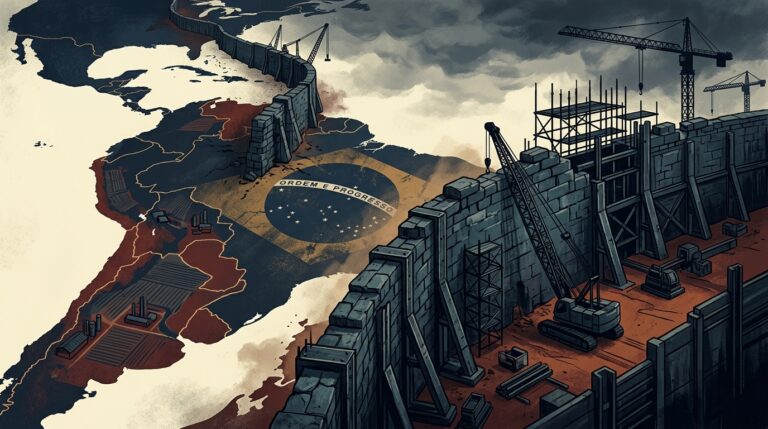
*Brazil’s IP-based retaliation could be the bigger story than the tariffs themselves*
The temporary tariff regime that has anchored US trade policy since April expires on July 24, 2026. In its place, Washington is standing up a new legal foundation for tariffs — one built on Section 301, not the emergency powers the Supreme Court struck down in February 2026. The first country to feel the new architecture is Brazil, and Brazil’s response is arriving through a channel most Section 301 coverage has ignored: intellectual property, not counter-tariffs.
For investors tracking exposure to agriculture, pharmaceuticals, and technology licensing revenue tied to Brazil, this is the question that matters right now — not whether tariffs on Brazilian goods will bite, but whether Brazil’s Economic Reciprocity Law opens a retaliation channel that other governments facing new Section 301 tariffs could copy.
What actually changed: Section 122 out, Section 301 in
Section 122 tariffs — the temporary, roughly 10% global baseline duties the administration used after the IEEPA-based tariff structure was invalidated — are set to expire July 24, 2026. Section 122 was always a bridge measure, capped in duration under US trade law, not a permanent tariff authority.
To avoid a lapse, the Office of the US Trade Representative (USTR) is shifting the legal basis for tariffs to Section 301 of the Trade Act of 1974, which allows tariffs tied to specific findings against a trading partner’s practices rather than a blanket emergency declaration. On July 15, 2026, USTR announced a 25% Section 301 tariff on Brazilian goods, with the measure taking effect July 22, 2026 — two days before the Section 122 baseline lapses.
Policy stage tag: this is an announced-and-effective action, not a proposal. USTR has published the 25% rate and the effective date; it is not sitting in a comment period or awaiting congressional action. Section 301, unlike Section 122, is designed to survive legal challenge because it rests on a different statutory basis than the one the Supreme Court rejected in February.
A short pause here is worth taking: the timeline is tight by design. Two days separate the old wall coming down and the new one going up.
Why Brazil can’t just tariff back
Here is where most coverage of the Brazil dispute stops short. The obvious retaliation playbook — matching US tariffs with Brazilian tariffs on US goods — runs into a structural problem: the United States sells Brazil more than Brazil sells the United States in several key categories, so a tit-for-tat tariff war would cost Brazil more, proportionally, than it costs Washington. Brazilian officials and trade analysts have framed conventional counter-tariffs as an ineffective lever precisely because of this imbalance.
We should flag the uncertainty here explicitly: the exact bilateral trade balance figures for 2026 were not published in the source material reviewed for this article, so the “surplus” framing above should be read as a structural relationship described in trade analysis, not a specific dollar figure we can independently verify. Readers seeking precise, current bilateral trade data should consult the US Census Bureau’s foreign trade division or USTR’s country page directly.
Brazil’s government, through its official channels (Secom) and regional reporting, condemned the 25% tariff and confirmed it is moving to activate the Economic Reciprocity Law — a 2024 statute designed for exactly this kind of asymmetric standoff. This is a claim by the Brazilian government, not yet an independently confirmed enforcement action — Brazil has announced its intent and legal authority to act, but the specific measures had not been finalized in the source material reviewed here.
The Economic Reciprocity Law: tariffs are not the weapon
The mechanism matters more than the headline rate. Rather than raising duties on US imports, the Economic Reciprocity Law allows Brazil to suspend intellectual property protections — patents, licensing terms, and related commercial rights — held by companies from a country found to be imposing unjustified trade restrictions.
That is a materially different threat than a tariff. Tariffs raise the cost of physical goods crossing a border. Suspending IP rights hits the revenue model of sectors where the product *is* the intellectual property: patented seed traits, on-patent pharmaceuticals, and licensed software or platform technology. Brazil’s agricultural sector is one of the largest buyers of patented seed genetics globally, its pharmaceutical market is a significant destination for on-patent US drugs, and its technology sector runs on licensed US software — three high-margin categories where an IP suspension threatens royalty and licensing income rather than shipment volume.
On the ground, implementation is being managed through an interministerial committee chaired by Vice President Geraldo Alckmin, which is also responsible for identifying exemptions to the US tariff list for goods Brazil considers essential or non-substitutable. Stage tag: the exemption process and the IP-suspension mechanism are both in an active administrative design phase — announced and structurally enabled by existing law, but the specific list of suspended IP rights had not been finalized in the source material reviewed for this article.
Who is actually exposed
This is where the story becomes decision-relevant rather than merely diplomatic.
- US agricultural biotech and seed companies with patent-protected genetics licensed into the Brazilian market face a scenario — not a confirmed outcome — in which royalty streams could be interrupted if Brazil moves from legal authority to specific suspension orders.
- US pharmaceutical companies with on-patent drugs sold in Brazil face a comparable exposure path through the same statute, though which drug classes might be targeted has not been specified in official material reviewed here.
- US technology licensors — software, platform, and hardware IP licensed into Brazilian enterprise and consumer markets — sit in the same exposed category described by the law’s scope.
- Brazilian exporters facing the 25% Section 301 tariff directly bear the near-term US market-access cost, though the interministerial committee is actively working exemption carve-outs for goods deemed essential.
None of this constitutes investment advice or a signal to trade around a specific stock or sector. It is a map of exposure, not a forecast of loss.
The base case and the risk case for global trade
Base case (informational, not a prediction): Section 301 becomes the administration’s primary durable tariff tool as Section 122 lapses on July 24, 2026, with Brazil serving as the first test case among what reporting describes as a wider rollout targeting dozens of countries. In this case, IP-based retaliation remains one country’s legal tool rather than a global norm, and negotiation through the Alckmin-led committee narrows the practical impact through exemptions.
Risk case (conditional scenario, not a prediction): if Brazil moves from statutory authority to specific IP-suspension orders and those orders visibly reduce US licensing or patent revenue, other countries facing new Section 301 tariffs — with their own asymmetric trade balances against the US — could examine similar IP-based statutes rather than conventional tariffs. In that scenario, the friction point in global trade shifts from customs duties, which are relatively easy to model, to intellectual property enforcement, which is far harder for markets to price. This is a conditional path, not a stated policy outcome; no government beyond Brazil has announced an equivalent IP-suspension action in the material reviewed for this article.
What we still don’t know
Several material gaps remain, and none should be papered over with confident language:
- The precise list of goods or IP categories Brazil will actually suspend has not been published in the source material reviewed here — only the legal authority and the administrative process (the Alckmin-led committee) have been confirmed.
- Exact current-year bilateral US-Brazil trade balance figures were not present in the sources reviewed; the “surplus” dynamic cited above is a structural claim from trade analysis, not a verified 2026 dollar figure.
- Whether the Section 301 rollout against dozens of other countries will trigger comparable IP-based retaliation elsewhere is unconfirmed; this remains a scenario, not a forecast.
- No independent (non-Brazilian-government) confirmation of an actual, executed IP suspension order was available in the material reviewed as of this writing.
Next watchpoint
The two dates that will resolve the biggest open questions are close together. Section 122 tariffs lapse on July 24, 2026, testing whether the Section 301 replacement structure holds without a legal gap. The 25% Section 301 tariff on Brazil takes effect July 22, 2026. Watch for two concrete follow-ups: (1) any published exemption list from the Alckmin-led interministerial committee, and (2) any formal notice from Brazil specifying which IP rights are being suspended under the Economic Reciprocity Law. Either document would move this from legal-authority stage to enforcement stage — the distinction that matters most for anyone assessing exposure in agriculture, pharma, or technology licensing tied to Brazil.
—
*This article is for informational purposes only and does not constitute financial, legal, or tax advice. It does not recommend buying, selling, or holding any security, currency, or asset, and it does not predict specific price, rate, or investment outcomes. Trade policy actions described here are subject to change, legal challenge, and revision. Readers should consult a licensed financial, legal, or tax professional before making decisions based on developments in US-Brazil trade policy.*
Want the full institutional-style PDF version? Enter your email for the free PDF.