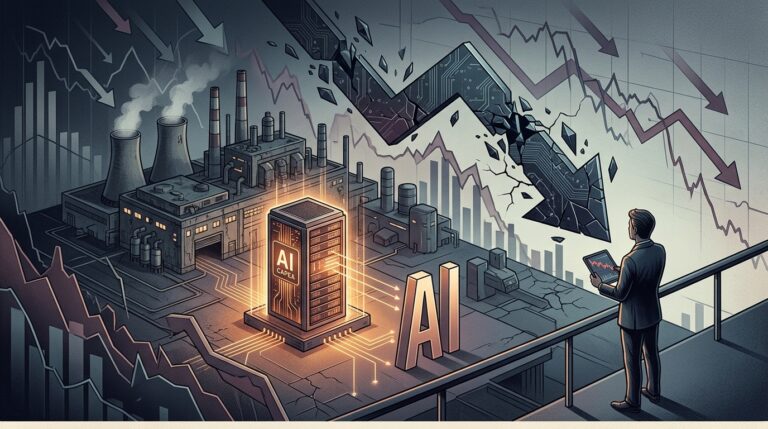
Semiconductor Bear Market: Why AI Capex Isn’t Enough
The Philadelphia Semiconductor Index (SOX) has fallen into a technical bear market even as Taiwan Semiconductor Manufacturing Co. just posted record profit and raised its capital spending plan. That combination — and not a generic “AI bubble” story — is the real signal investors need to parse this week.
The SOX closed at 11,673.89 on July 17, 2026, down 20.2% from its June 22 peak, meeting the standard definition of a technical bear market (https://finance.yahoo.com/quote/%5ESOX). The drop happened in the same week that TSMC, the foundry that makes the advanced chips powering nearly every major AI system, reported a 77% jump in quarterly profit and raised its 2026 capital expenditure guidance to a range of $60 billion to $64 billion, roughly 15% higher at the midpoint than prior guidance. Under the old playbook, a foundry raising capex guidance by double digits should have been read as unambiguously bullish for the whole semiconductor supply chain. It wasn’t. That gap between the fact pattern and the market’s reaction is this article’s focus.
What Actually Changed in the Numbers
Three data points anchor this story, and each comes from a verifiable release rather than commentary.
First, the SOX’s 20.2% slide from its June 22 high to its July 17 close is a measured, benchmarked move, not a subjective “rout” (https://finance.yahoo.com/quote/%5ESOX). Second, TSMC’s own disclosure shows the 77% profit jump alongside the raised $60–$64 billion capex range for 2026. Third, the broader S&P 500 is not showing any earnings-side weakness that would explain a sector-specific rout: the blended Q2 2026 earnings growth rate for the index stood at 24.7%, with estimates revised upward by 3.4% during the quarter — an unusually strong revision trend for this stage of an earnings season.
Put simply: the index-level earnings backdrop was strong, the leading chip supplier’s own results were strong, and the semiconductor-specific sub-index still fell into a bear market. That is the disconnect existing coverage has largely described but not explained.
The Trigger Everyone Cites: Kimi K3
Much of the sell-off has been attributed to the July 17, 2026 release of Moonshot AI’s Kimi K3 model out of China, which stoked investor anxiety over what commentary has termed “semiconductor fatigue” — worry that massive AI infrastructure spending may outrun the software layer’s ability to monetize it. Market commentary has treated Kimi K3 as the proximate cause, and the timing — the same day as the SOX’s bear-market close — does line up (https://finance.yahoo.com/quote/%5ESOX;
But a single open-weight model release, however capable, does not on its own explain why a foundry’s *higher* capex guidance would be read as bad news. A trigger and a mechanism are different things. The trigger may be Kimi K3. The mechanism is something else.
The AI Capex Paradox: More Spending, More Skepticism
Here is the mechanism, and it is where existing coverage stops short. TSMC’s raised $60–$64 billion 2026 capex figure is good news for TSMC’s own order book and for equipment suppliers further up its chain — that part is a straightforward FACT tied to the company’s own disclosure. But that same dollar figure is also a cost line for the hyperscalers and AI labs who ultimately buy the chips TSMC fabricates. Higher foundry capex today tends to show up, with a lag, as higher equipment and capacity costs passed through the supply chain.
This is where the analysis in this piece diverges from the “profit-taking rotation” framing that has dominated recent coverage: the same $60–$64 billion figure can be simultaneously bullish for the chip supplier reporting it and a source of margin-pressure anxiety for the downstream buyers who have to justify that spending to their own shareholders. Both readings are consistent with the same disclosure — they are not contradictory facts, they are two different vantage points on one number.
Why Kimi K3 Sharpens That Pressure
This is the connective tissue between the two supposedly separate stories — the chip sell-off and the Kimi K3 release. An open-weight model that performs competitively lowers the technical and cost barrier for building AI applications without paying for the most expensive proprietary infrastructure. If open-weight competition keeps intensifying, it raises a legitimate question — not a settled fact — about whether hyperscalers can extract enough incremental revenue from their AI infrastructure to justify capex increases of the size TSMC just guided to. That question is exactly what appears to be repricing semiconductor-linked equities, independent of how strong any single quarter’s chip earnings look.
None of this means AI infrastructure spending is being abandoned. TSMC’s own guidance says the opposite: capex is going up, not down. What appears to be shifting is the market’s willingness to reward that spending automatically. The evidence points toward investors now separating two questions that used to be treated as one: “is AI infrastructure supply growing?” (yes, by TSMC’s own numbers) versus “is AI infrastructure demand monetizing fast enough to justify that supply?” (unresolved, and the source of the current anxiety).
Economic Backdrop: Capital Intensity Doesn’t Stop at Chips
Semiconductor capex decisions do not happen in a vacuum, and one overlooked input-cost variable belongs in this discussion: energy. Data centers that run advanced AI chips are large, continuous power consumers, and their operating economics are sensitive to energy prices even when the headline story is about chip orders rather than oil markets. West Texas Intermediate crude was priced at $79.20 per barrel as of July 13, 2026, according to Federal Reserve Economic Data (https://fred.stlouisfed.org/series/DCOILWTICO). That figure does not by itself explain the SOX’s bear-market move — WTI is a crude oil benchmark, not a direct semiconductor cost input — but it is a relevant macro data point for readers assessing the total capital intensity of AI infrastructure: chip capex, power procurement, and cooling costs are all rising simultaneously in this cycle, and none of the three is currently falling. We flag this explicitly rather than implying causation the underlying data does not support.
Who This Actually Affects, and What Choices Emerge
This regime shift has different implications depending on where an investor or observer sits in the AI supply chain, and existing coverage rarely separates these groups.
Chip and equipment suppliers (foundries, memory makers, capital-equipment vendors) are, per TSMC’s own disclosure, still seeing order strength reflected in raised capex guidance. Their near-term revenue visibility is a fact-based positive even as their share prices have been swept into the broader SOX decline.
Hyperscalers and AI labs that buy this capacity face the opposite pressure: rising per-unit infrastructure costs at a time when open-weight competition from models like Kimi K3 may compress what they can charge for AI services built on that infrastructure. Their upcoming earnings calls, where analysts are likely to press for specifics on AI revenue attribution versus AI spending, become materially more decision-relevant than usual this quarter.
Investors holding broad semiconductor exposure (whether through individual names or index-tracking vehicles tied to the SOX) are now navigating a market that, per the 20.2% bear-market decline against a strong S&P 500 earnings backdrop, is pricing sector-specific monetization risk separately from overall corporate profit growth (https://finance.yahoo.com/quote/%5ESOX; This article does not tell readers whether to add, hold, or reduce exposure to any name or fund; it identifies the specific variable — monetization evidence versus capex growth — that appears to be driving the current repricing.
What Remains Unknown
Several things are genuinely unresolved and should not be presented as settled. It is not yet known how much of Kimi K3’s capability will translate into actual enterprise adoption away from proprietary models, or whether that shift, if it happens, is temporary or structural. TSMC’s raised capex range of $60–$64 billion is guidance, not a completed spending record, and guidance can be revised in either direction in future quarters. It is also not established whether the SOX’s 20.2% decline reflects a durable repricing of AI monetization risk or a shorter-term technical correction inside a longer uptrend; both remain plausible readings of the same price data, and this article does not resolve that question in either direction.
If hyperscaler earnings calls over the coming weeks show concrete AI-linked revenue growth that keeps pace with capex increases, the “monetization gap” narrative driving the current sell-off could ease. If instead those calls show AI capex continuing to outpace disclosed AI revenue, the current skepticism toward semiconductor names may persist or deepen. Both are scenarios, not forecasts, and neither outcome is guaranteed.
Next Watchpoint
The next concrete test is the run of hyperscaler and AI-lab earnings calls in the coming weeks, where analysts are expected to press management on AI-specific revenue disclosure versus capital spending — the same tension this article identifies in TSMC’s own numbers. A second dated marker is any revision to TSMC’s $60–$64 billion 2026 capex guidance in its next quarterly update, which would directly confirm or walk back the capital-intensity trend discussed here. Readers tracking the semiconductor sector should watch both dates rather than the daily SOX print alone.
—
*This article is for informational purposes only and does not constitute financial, investment, legal, or tax advice. It does not recommend buying, selling, or holding any specific security, sector, or fund. Market conditions, earnings figures, and guidance cited above are subject to revision. Readers should consult a licensed financial, legal, or tax professional before making investment decisions.*
Want the full institutional-style PDF version? Enter your email for the free PDF.