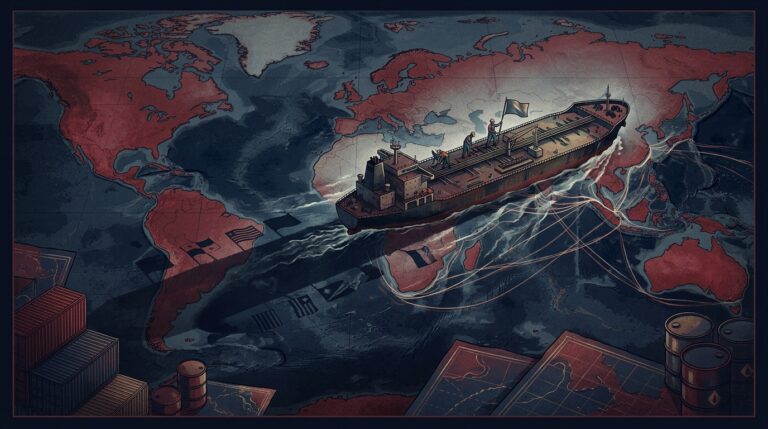
European coastal states and the UK have tightened maritime, insurance, and inspection pressure on the logistics network carrying Russian seaborne crude. The result has not been a simple interruption of oil flows. It has been a deeper split in tanker markets, as operators move away from Western insurance, open registries, and standard compliance channels toward Russian registration and parallel trading loops.
That shift is reshaping freight availability. Mid-size crude tankers tied to Russian trades are becoming less available to standard charter markets, while compliant vessels face tighter supply and stronger rate pressure.
Enforcement Pressure Meets Logistical Adaptation
The European Commission has designated over 550 vessels and imposed port access bans aimed at evasion practices linked to Russian oil transport (European Commission). The UK sanctions package dated October 1, 2026, also expands inspection pressure on targeted vessels, according to Hill Dickinson’s legal analysis (Hill Dickinson).
Those measures sit on top of the broader oil price cap and maritime services framework, which relies heavily on access to Western shipping services and G7-linked Protection and Indemnity insurance (European Commission). The enforcement logic is clear: vessels that cannot document compliance face reduced access to mainstream insurance, ports, and services.
Yet CREA’s monthly tracking shows that Russian seaborne crude and oil product exports have continued to reach international buyers despite this pressure (CREA). The evidence points less to immobilized supply than to an adaptive logistics system that absorbs enforcement friction by changing registry, insurance, and routing patterns.
Why Reflagging Matters
A central adjustment is reflagging. Hill Dickinson notes a trend of operators moving vessels to the Russian maritime registry as pressure rises on traditional flags of convenience (Hill Dickinson). That legal shift matters because registration, insurance, and jurisdiction determine which authorities can exert practical control over a vessel.
For operators moving outside Western-linked service networks, Russian registration can pair with sovereign guarantees rather than G7-linked P&I cover. That does not remove operational risk, but it does move part of the fleet beyond the main enforcement perimeter used by the price cap system.
The effect is market segmentation. Tankers that once might have competed across a broader set of crude routes become tied more closely to Russian export flows and the buyers willing to use parallel logistics.
Aframax and Suezmax Markets Split
Kpler identifies the strongest market impact in the Aframax and Suezmax segments, where a growing shadow fleet can reduce the fungibility of mid-size crude tanker capacity (Kpler).
The mechanism is straightforward. When vessels move into a dedicated Russian trade loop, they are no longer fully available for standard international chartering. That smaller pool of compliant, fully insured tonnage can place upward pressure on Aframax freight rates. At the same time, longer voyages to non-European buyers keep ships occupied for extended periods, increasing ton-mile inefficiency.
Kpler’s analysis also links this segmentation to a wider logistics margin between FOB and delivered pricing (Kpler). The article should not be read as proving a precise rate premium or crude-spread figure; the supplied evidence supports the direction of the pressure, not a precise market-wide price estimate.
Export Flows Remain the Key Test
CREA’s July and August monitoring tracks Russian oil moved by shadow tankers and G7-insured vessels, giving a basis for assessing whether enforcement changes vessel behavior without immediately halting exports (CREA, CREA).
That distinction is important. Enforcement can raise compliance costs, reduce access to mainstream services, and increase safety or liability concerns while still leaving physical export volumes resilient. In the current market structure, the visible outcome is not a clean stop in Russian seaborne trade. It is a more fragmented tanker system with separate compliance, insurance, and routing realities.
Unresolved Freight and Liability Risks
Several variables remain difficult to quantify. The exact impact on charter rates and crude price spreads depends on localized arbitrage conditions, vessel availability, and route economics that change daily.
A larger unresolved issue is liability. The long-term viability of Russian sovereign reinsurance remains untested in a major maritime incident. It is still unclear how coastal states would handle environmental liability, emergency salvage, or port-state intervention if a Russian-flagged, non-G7-insured tanker required assistance in European waters.
For tanker markets, the central question is whether enforcement keeps pushing vessels into a parallel system faster than compliant capacity can adjust. If that pattern persists, the pressure point may remain freight availability and logistics opacity rather than headline export volume alone.
Disclaimer: This article is for informational purposes only and does not constitute financial, legal, or tax advice. This article was researched and drafted with AI assistance. Market participants should consult licensed professionals before making investment or chartering decisions based on geopolitical developments.
October 2026 Watchpoints for Tanker Markets
- UK inspection enforcement: Whether the October 1, 2026, UK inspection powers lead to physical vessel detentions or mainly administrative friction (Hill Dickinson).
- Export volume revisions: Whether CREA’s next monthly tracking shows any disruption in seaborne crude and oil product exports as registry and insurance structures continue to shift (CREA).
- Aframax capacity metrics: Whether Kpler’s tanker-market updates show further tightening in compliant mid-size crude tonnage available outside Russian-linked trade routes (Kpler).
Want the full institutional-style PDF version? Enter your email for the free PDF.