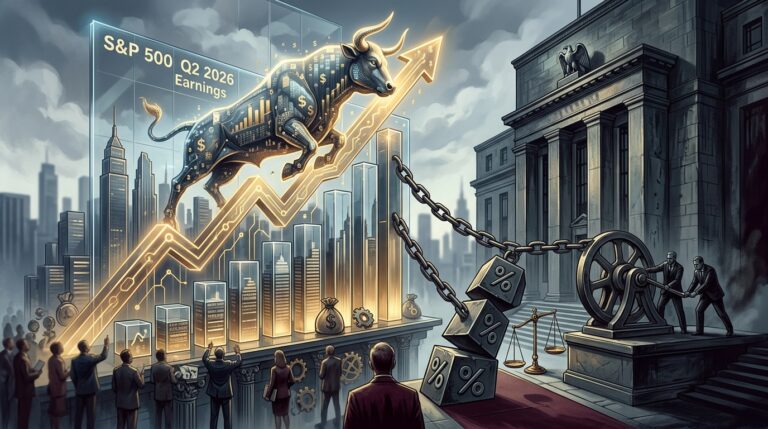
Wall Street just got an earnings season that almost never happens — and that’s the problem.
Analysts raised S&P 500 Q2 2026 earnings estimates by 3.4% between March 31 and June 30, a move that runs directly against the historical pattern of estimate cuts of 2% to 4% heading into earnings season. The blended earnings growth rate for the quarter now stands at 24.7%. That is the S&P 500 Q2 2026 earnings story most outlets are running with. What’s missing from most of that coverage is the second half of the sentence: the same forces pushing those numbers up are the forces the Federal Reserve is now citing as reasons it might raise, not cut, interest rates.
Why S&P 500 Q2 2026 Earnings Estimates Keep Climbing
Two sectors are doing most of the lifting. According to FactSet’s earnings tracking data behind the 3.4% revision figure, Information Technology and Energy are posting the steepest year-over-year EPS growth of any S&P 500 sector this quarter, driven respectively by AI infrastructure capital spending and a run-up in energy prices.
Here’s the part that connects to the Fed rate hike debate. The Bureau of Labor Statistics’ June 2026 CPI release shows headline CPI-U up 3.5% year-over-year, with energy prices up 15.7% and gasoline specifically up 26.7%. Energy companies are booking record profit growth off the same price increases that are showing up in the government’s inflation gauge. That is not a coincidence of timing — it is the same price move measured from two different sides of the transaction.
The Fed’s Hawkish Pivot: What Warsh and Hammack Are Actually Saying
Fed Chair Kevin Warsh told reporters at his press conference that “prices are too high,” and the Fed reduced the specificity of its forward guidance following that meeting. That is a claim attributed directly to the Fed chair, not an independently verified inflation forecast.
Cleveland Fed President Beth Hammack has gone further in public remarks, warning that inflation is running too high and that price pressure is broad-based across the economy rather than confined to one or two categories. Again — this is a policymaker’s stated position, not a released Fed committee decision. No rate hike has been announced or voted on as of this writing.
Short pause here: neither official has committed to a specific rate path. What they have done is narrow the space between “hold” and “hike.”
Good News Is Bad News: The Feedback Loop Behind the S&P 500 Earnings Surge
This is where most coverage stops treating the earnings boom and the Fed pivot as one story. Our analysis is that they are mechanically linked, not merely coincidental in timing.
AI infrastructure capital spending is the leading driver of Information Technology’s outsized EPS growth this quarter. That same wave of data-center and grid-related spending is a documented driver of higher electricity and industrial demand, which shows up on the other side of the ledger as the energy-price inflation the BLS is now recording. In other words: the capex that is lifting IT-sector profit estimates and the energy demand that is lifting Energy-sector profit estimates are two branches of the same spending surge that Hammack points to when she describes inflation as broad-based.
A competing read exists. It is possible to argue the earnings surge and the inflation print are only loosely correlated — that oil-supply dynamics and AI capex are separate macro stories that happen to be moving at the same time. The evidence pack available for this article cannot fully rule that alternative out; sector-level correlation is not the same as proven causation, and no formal econometric attribution study is cited in the sources reviewed here.
Base case, framed as analysis, not prediction: if the sectors driving the S&P 500 Q2 2026 earnings beat are the same sectors keeping headline and energy CPI elevated, then stronger-than-expected earnings prints this summer would tend to reinforce, rather than undercut, the Fed’s inflation concerns — precisely because the mechanism financial markets usually cheer (record corporate profit growth) is the same mechanism the Fed watches for price stability risk.
Risk case, framed as a conditional scenario: if Fed officials continue to describe inflation as broad-based and elevated in the months ahead, and if that view hardens into committee consensus, a scenario in which policy shifts toward tightening rather than the previously anticipated easing path becomes more plausible. This is a scenario, not a forecast — the Fed has not announced any rate decision tied to Q2 earnings data as of this writing.
Who This Affects and What to Watch
Equity holders concentrated in AI-infrastructure and energy-linked names are the most directly exposed to this feedback loop, since those are the same sectors carrying both the earnings upside and the inflation exposure flagged by BLS data. Rate-sensitive segments — long-duration growth stocks, REITs, and small-cap borrowers — face a different exposure: any confirmed hawkish shift from the Fed would raise their financing costs independent of how their own earnings are trending. This article does not recommend buying, selling, or rotating into or out of any of these groups; it identifies which fact set matters for readers making their own assessment.
What Remains Unclear
Several things are genuinely unresolved with the sources available. First, no committee-level Fed vote or dot-plot update tied to this specific inflation read has been cited here — Warsh’s and Hammack’s comments are individual and institutional statements, not a finalized policy path,. Second, the exact size of the causal contribution from AI-related capex and energy demand to the June CPI print has not been isolated in the sources reviewed; the sector-level correlation described above is a reasonable inference, not a measured decomposition. Third, how the remaining weeks of Q2 earnings season — outside of IT and Energy — will shift the blended 24.7% growth figure is still open, since roughly half of S&P 500 companies had not yet reported as of the estimate window used here.
Next Watchpoint
The next concrete data points to track: the BLS’s July 2026 CPI report, typically released roughly a month after the reference month and the natural successor to the June reading cited above; remaining S&P 500 Q2 earnings prints from AI-infrastructure and energy-linked companies through early August; and any follow-up public remarks or a formal FOMC statement from Warsh or Hammack that would move this from individual commentary toward committee-level policy. Readers tracking rate-sensitive holdings should watch for whether the next FOMC statement changes its forward-guidance language, not just its rate decision.
—
*This article is for informational purposes only and does not constitute financial, investment, legal, or tax advice. It does not recommend buying, selling, or holding any security, and it does not predict future Federal Reserve policy actions or market returns. Statements about possible future scenarios are conditional and explicitly not guarantees. Readers should consult a licensed financial advisor or tax professional before making investment decisions.*
Get This Report as a PDF
Enter your email to receive the full analysis report as a PDF.