U.S. dollar stablecoin market capitalization grew by 30 percent ($71 billion) to approximately $308 billion following the July 2025 passage of the GENIUS Act New York Fed Liberty Street Economics. This rapid expansion under new statutory frameworks has fundamentally altered how digital capital interacts with traditional sovereign debt.
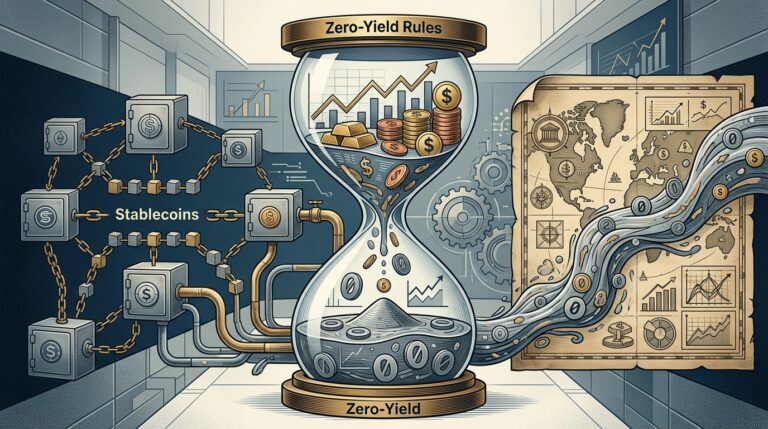
Statutory prohibitions preventing payment stablecoin issuers from passing Treasury yields to token holders have created a dual-track digital dollar economy. Standard payment tokens provide zero-yield transactional liquidity while funneling inelastic demand into front-end Treasury bills. Meanwhile, yield-seeking institutional capital disintermediates into tokenized money funds and secondary lending markets. This bifurcation distorts short-end sovereign debt pricing and complicates official monetary aggregates.
The Dual-Track Digital Dollar Economy
The core friction stems from the regulatory mandate that payment stablecoins cannot distribute the yield generated by their underlying reserve assets. Issuers absorb the interest from the short-term government debt backing their tokens, leaving the on-chain holder with a strictly non-interest-bearing instrument.
This dynamic forces a wedge into the market. Capital that requires immediate, permissionless settlement remains in zero-yield stablecoins. Conversely, institutional capital that demands a return on idle cash is pushed toward alternative structures, such as tokenized Treasuries or decentralized lending protocols, which carry different risk profiles and regulatory classifications.
Stablecoin Treasury Yield Impact
The sheer scale of zero-yield stablecoin reserves actively alters pricing dynamics in the traditional bond market. Because stablecoin issuers must maintain dollar parity, their demand for safe, short-duration assets is highly inelastic. They buy Treasury bills regardless of the prevailing yield.
Econometric data confirms this structural distortion. A 2-standard-deviation stablecoin inflow lowers 3-month Treasury bill yields by 2.5 to 3.5 basis points under normal market conditions, escalating to 5 to 8 basis points during periods of bill scarcity BIS Working Paper 1270. When the supply of short-term government debt tightens, the forced buying from stablecoin reserve managers disproportionately compresses the short end of the yield curve.
Measurement Risks in M1 and M2 Aggregates
Beyond yield compression, the integration of stablecoins into the broader financial system creates severe accounting challenges for central banks. The Federal Reserve Board explicitly evaluates double-counting risks and liquidity characteristics when incorporating reserve-backed payment stablecoins into U.S. monetary aggregates M1 and M2 Federal Reserve FEDS Notes.
If a stablecoin is backed by a commercial bank deposit or a Treasury bill, counting both the underlying traditional asset and the circulating digital token artificially inflates the perceived money supply. This double-counting risk obscures true liquidity conditions, potentially complicating the Federal Reserve’s ability to accurately gauge macroeconomic tightening or easing.
Unresolved Structural Frictions
Several variables remain unmapped in this evolving market structure. It is not yet clear how regulatory bodies will permanently resolve the M1 and M2 double-counting discrepancies. Furthermore, the long-term resilience of short-term Treasury market functioning during a severe, correlated crypto-market liquidation event remains a theoretical risk rather than a tested outcome. The exact threshold at which stablecoin reserve liquidations might trigger broader Treasury market dysfunction is currently unknown.
Next Watchpoint for Investors
The next critical indicator for market participants is the upcoming Federal Reserve H.6 statistical release on money stock measures. Observers should monitor this release for any preliminary methodological adjustments or footnotes addressing stablecoin double-counting, which could signal a formal shift in how central banks classify on-chain liquidity.
Related Analysis
- Tokenized Treasuries and Wholesale Rails: Why Digital Cash Replaced the Retail CBDC Playbook
- Tokenized Treasuries vs Stablecoins: A 2026 Deep Dive
- Stablecoin Supply Drops, Volume Soars: Why?
- GENIUS Act Yield Ban Fuels Tokenized Treasury Margin
- CLARITY Act Stablecoin Rewards Impact on Bank Deposits
Disclaimer: This article is for informational purposes only and does not constitute financial, investment, legal, or tax advice. This article was researched and drafted with AI assistance. The analysis presented does not guarantee future market performance or specific price outcomes. Readers should consult with a licensed professional before making any investment decisions.
Want the full institutional-style PDF version? Enter your email for the free PDF.