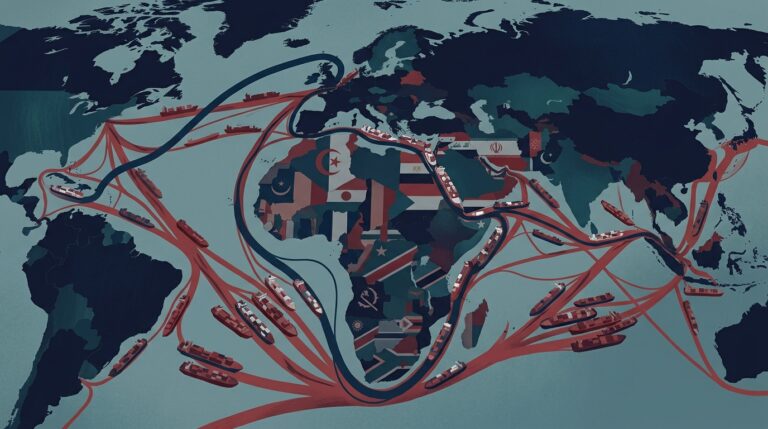
Global trade is entering a consequential reset in maritime routing. After months of Cape of Good Hope diversions, container capacity is moving back toward the Red Sea and the Suez Canal. The immediate focus is often security risk and voyage costs, but the larger market impact is network velocity: shorter routes allow ships to complete rotations faster, making more capacity available without any new vessel entering service.
That capacity release is arriving alongside a major delivery cycle. The result is a sharper oversupply risk for container shipping heading into 2027, especially if Suez transits continue to recover while the global fleet keeps expanding.
Suez Transit Capacity Is Rebounding
The return to the main Asia-Europe corridor is visible in shipping data. BIMCO analysis released on October 14, 2026 said weekly container capacity transiting the Suez Canal averaged 753,000 TEU during the first two weeks of October. That was more than 50% of the 1,457,000 TEU pre-disruption level recorded in October 2023 (BIMCO).
IMF PortWatch tracks vessel activity and trade-volume indicators across chokepoints including the Bab el-Mandeb Strait, the Suez Canal, and the Cape of Good Hope (IMF PortWatch). Those data can show the pace of routing normalization, but they do not by themselves prove carrier intent or remove the continuing security constraint around the southern Red Sea.
Why Shorter Routes Release Capacity
Cape diversions changed more than fuel use and sailing distance. Longer rotations forced carriers to commit more vessels to maintain service frequency. That absorbed ships that might otherwise have been available elsewhere in the network.
A return toward Suez reverses that effect. Maritime Executive, citing market analysis, reported that full route normalization away from the Cape of Good Hope detour could reduce effective container-ship demand by 10% (Maritime Executive). In practical terms, faster round trips can return ships to service sooner, creating effective supply even before newbuild deliveries are counted.
This is the core paradox for carriers: the same routing improvement that restores schedule efficiency can also weaken the capacity discipline created by disruption.
Fleet Growth Adds Pressure
The capacity release is occurring as the container fleet reaches a new scale. Safety4Sea, reporting BIMCO figures, said the global container fleet crossed 34 million TEU after expanding 42%, or 10 million TEU, over the five and a half years since early 2021 (Safety4Sea).
Supply pressure is expected to intensify. Maritime Executive reported that fleet capacity growth is projected at 4.6% for 2026 and forecast to accelerate to 9% in 2027, with an orderbook above 14 million TEU (Maritime Executive).
The combination is significant: route normalization could release capacity from existing vessels while shipyards continue adding new capacity to the fleet.
The 2027 Oversupply Scenario
If Suez transits keep moving back toward their 2023 baseline, the artificial capacity absorption created by Cape diversions could fade. That would leave the market facing both unfrozen tonnage and a large delivery pipeline at the same time.
Such a scenario would point to weaker freight-rate conditions, particularly in lanes exposed to Asia-Europe capacity. It could also lower transport-cost pressure for importers, though any broader effect on traded-goods inflation would depend on demand, contract timing, and security conditions.
The outlook remains conditional. A deterioration in Red Sea security could push carriers back toward the Cape of Good Hope and absorb capacity again. That makes the next phase less a simple normalization story than a test of how durable the Suez return proves to be.
What To Watch
- Suez transit capacity: Whether the 753,000 TEU weekly average holds or expands through November 2026.
- Cape of Good Hope traffic: Whether diversions continue to unwind or return because of security concerns.
- Fleet delivery discipline: Whether carriers adjust delivery timing against an orderbook above 14 million TEU.
- Freight contract negotiations: How projected 9% fleet growth in 2027 affects Asia-Europe and trans-Pacific annual contract discussions in the first quarter.
Disclaimer: This article is for informational purposes only and does not constitute financial, investment, legal, or tax advice. This article was researched and drafted with AI assistance. Market conditions and geopolitical risks are subject to rapid change. Readers should consult licensed professionals before making any business or investment decisions.
Want the full institutional-style PDF version? Enter your email for the free PDF.