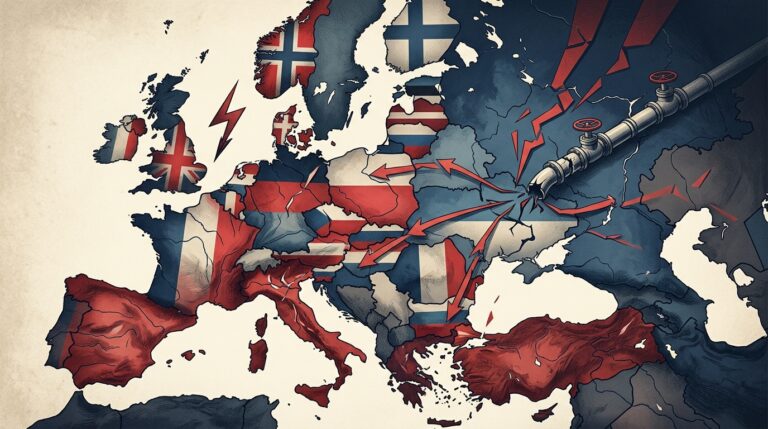
The expiration of the Naftogaz-Gazprom transit agreement changed the economic map of European gas without immediately producing the acute physical shortages some market participants had feared. The loss of 15 billion cubic meters (bcm) in annual flow via the Sudzha interconnection point was absorbed through a broader adjustment involving storage, LNG-backed western hubs, reverse-flow capacity, and alternative routing. That adjustment preserved supply adequacy, but it also exposed a more uneven regional cost structure.
European energy authorities identified reverse-flow pipeline corridors through Germany and Italy as part of the response for landlocked markets including Slovakia and Austria (official source). The shift helped keep gas moving, but it changed the commercial route into those markets. Instead of receiving direct eastern pipeline volumes, buyers increasingly depend on gas that may enter through western LNG terminals or northwest European hubs before crossing several transmission systems.
Reverse Flows and Tariff Stacking
The central problem is not only the availability of molecules. It is the cost of moving them. Gas delivered from western entry points to Vienna, Bratislava, or nearby landlocked markets can pass through multiple national transmission systems. Each step can involve capacity charges, exit tariffs, entry tariffs, or other regulated cost items.
Austria’s energy regulator, E-Control, has tracked changing import routes and cross-border capacity fee structures as the region reduces its long-term reliance on Russian pipeline gas (official source). The International Energy Agency has also highlighted how cross-border storage exit charges and transit levies can distort trade across neighboring European gas systems. Germany’s Gasspeicherumlage, a neutrality levy linked to the cost of filling strategic reserves, is a prominent example because it has applied at cross-border interconnection exit points (official source).
These charges do not affect every country in the same way. Coastal northwest European markets have more direct access to LNG terminals and liquid trading hubs, while landlocked buyers are more exposed to the cumulative cost of moving gas across borders. The result is a more fragmented price environment: physical supply can remain adequate even as regional basis costs widen and affordability pressures become more uneven.
Storage Incentives Under Pressure
The end of predictable Ukrainian transit also matters for seasonal storage economics. European utilities have traditionally bought cheaper gas during the summer, injected it into underground storage, and withdrawn it during winter demand peaks. That model depends on a normal contango structure, where winter gas prices are high enough relative to summer prices to cover storage costs and leave a commercial margin.
Argus Media documented a seasonal forward-curve inversion in which the TTF front-summer gas contract traded at €40.86/MWh, while the front-winter delivery contract traded at a €0.505/MWh discount (official source). When summer gas is priced at or above winter gas, the usual profit signal for storage injection weakens or disappears. For landlocked markets, cross-border fees can worsen that signal because the delivered cost of filling storage may exceed what the forward curve can justify.
This does not mean storage becomes physically unavailable. It means the burden can shift from ordinary commercial arbitrage toward policy mechanisms, strategic reserve rules, or cost-recovery structures. The IEA notes that gas storage mechanisms and flexibility requirements are increasingly connected to reserve-design and cost-recovery choices rather than pure market incentives alone (official source).
Regulatory Stakes
The durability of these price gaps will depend on how regulators treat cross-border charges and national levies. If exit fees, neutrality levies, and capacity charges remain layered along west-to-east routes, landlocked buyers could continue to face higher delivered costs than coastal northwest European markets. That would leave energy-intensive industries in Austria, Slovakia, and neighboring import-dependent markets more exposed to regional gas-price differentials.
If regulators narrow or remove the most distortionary cross-border charges, the gap between TTF-linked northwest European prices and central European delivery costs could ease. The central policy issue is therefore not whether Europe can move gas after the end of Ukrainian transit. It is whether the internal market can prevent the cost of that movement from becoming a lasting regional disadvantage.
Key Watchpoints for European Energy Markets
Market observers and industrial consumers should monitor these indicators ahead of the Q4 2026 heating season:
- TTF seasonal spreads: A return to contango would improve the commercial case for storage injection. Persistent summer-over-winter pricing would keep the incentive weak.
- Cross-border tariff changes: E-Control and other national regulators remain important sources for tracking capacity fees, route changes, and the treatment of transit-related levies.
- Treatment of neutrality levies: The legal and regulatory status of charges such as Germany’s Gasspeicherumlage will influence whether regional price fragmentation narrows or becomes more durable.
*Disclaimer: This article is for informational purposes only and does not constitute financial, legal, or investment advice. Energy commodity markets are highly volatile, and forward curve structures can change rapidly. Readers should consult licensed professionals before making any trading or investment decisions based on macroeconomic or geopolitical developments.*
Want the full institutional-style PDF version? Enter your email for the free PDF.