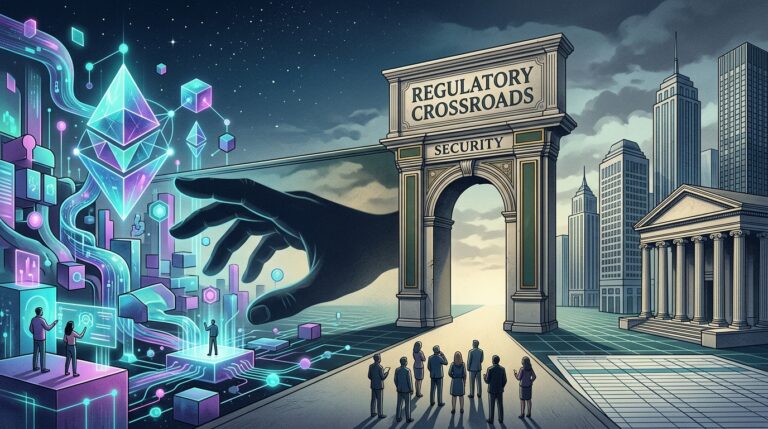
A landmark week of US crypto rule proposals from the Securities and Exchange Commission (SEC) and the Treasury Department has replaced ambiguity with a stark choice for digital asset protocols. While providing long-awaited clarity, the simultaneous release of the SEC’s Regulation Crypto Assets and the Treasury’s GENIUS Act rulemaking creates a fundamental paradox. The new US crypto rules force token issuers to choose between two mutually exclusive paths: complete decentralization to avoid securities classification or permanent centralization to comply with new federal stablecoin and banking standards.
The SEC’s Path: Decentralize to Disappear
The SEC’s proposed Regulation Crypto Assets, released August 18, aims to clarify how securities laws apply to digital assets Journal of Accountancy SEC crypto proposal report. A key feature is a proposed safe harbor for token projects that can demonstrate a complete cessation of managerial efforts by founders or a central entity. This ‘managerial cessation’ path would allow a token to transition from a security to a non-security commodity, but it requires the protocol to become truly autonomous and community-run, with no single group directing its development or profiting from its promotion InvestmentNews SEC crypto-regulation report. This framework is designed for protocols whose ultimate goal is to become immutable public infrastructure.
The Treasury’s Path: Centralize to Comply
In parallel, the Treasury Department’s proposed rulemaking under the GENIUS Act, announced August 17, establishes a federal framework for payment stablecoin issuers U.S. Treasury digital-assets rulemaking release. To operate legally in the US, stablecoin issuers must obtain federal licenses and adhere to strict requirements for asset reserves, operational transparency, and redemption capabilities Incrypted GENIUS Act stablecoin-rule report. This effectively treats stablecoin issuance as a banking function, demanding a permanent, centralized, and continuously managed corporate structure to oversee the balance sheet and ensure stability Thomson Reuters stablecoin rule report. This path is tailored for entities aiming to bridge traditional finance with digital assets.
The Structural Conflict in the New US Crypto Rules
The core challenge for the digital asset ecosystem is that these two paths are operationally incompatible. A protocol cannot simultaneously achieve the SEC’s standard of ‘managerial cessation’ while also meeting the Treasury’s requirement for continuous, centralized management of a stablecoin or tokenized asset portfolio. This creates a regulatory fork in the road for many DeFi projects. For instance, a decentralized lending protocol that wants to use a federally compliant, yield-bearing stablecoin as collateral would be relying on a centralized issuer. This reliance could undermine its own argument for being ‘sufficiently decentralized’ under the SEC’s framework, potentially jeopardizing the non-security status of its native governance token.
Market Impact: A Bifurcation of DeFi
This regulatory divergence is likely to split the DeFi landscape into two distinct models. One branch will pursue radical decentralization to fit the SEC’s safe harbor, likely forgoing the use of regulated stablecoins and certain tokenized real-world assets (RWAs) that require active management CryptoRank RWA tokenization report. The other branch will embrace centralization, registering as financial institutions to comply with Treasury rules and cater to institutional capital, which has shown significant interest in regulated products like ETFs KuCoin BTC and ETH ETF flows report. This second group will likely dominate the RWA space, where assets like BlackRock’s BUIDL fund require a designated manager RWA.xyz BUIDL data. The choice will define a protocol’s access to liquidity and its fundamental architecture.
What Remains Uncertain in the US Crypto Rules
As these are proposed rules, their final form is not yet set. The public comment period, accessible via the Federal Register, could lead to significant revisions that address this structural conflict Federal Register regulatory docket. Furthermore, the precise legal definitions of ‘managerial cessation’ and ‘sufficient decentralization’ will likely be refined through both regulatory guidance and future court cases. How non-US protocols will interact with this bifurcated American market also remains a significant open question, as does the global regulatory response to the new US framework.
Key Watchpoints for Market Participants
For those tracking the evolution of US crypto rules, the most immediate events are the deadlines for public comment on both the SEC and Treasury proposals. The official rulemaking tracker for the GENIUS Act will provide timelines for its final implementation Chapman GENIUS Act rulemaking tracker. Market participants should also monitor initial responses and legal challenges from major industry bodies, as these will signal the primary points of contention that could shape the final regulations.
*(Disclaimer: This article is for informational purposes only and does not constitute financial, legal, or tax advice. This article was researched and drafted with AI assistance. The digital asset market is volatile and subject to regulatory changes. Readers should consult with a licensed professional before making any investment decisions.)*
Want the full institutional-style PDF version? Enter your email for the free PDF.