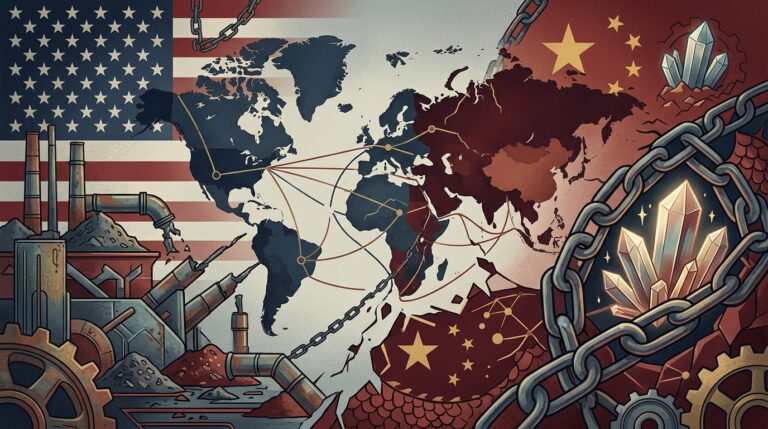
A statutory deadline requiring the U.S. defense industry to eliminate Chinese critical minerals is set for January 1, 2027, but a massive domestic supply deficit makes compliance without significant procurement delays a mathematical impossibility. This sets up a direct conflict between national security policy and industrial reality.
The 2027 Deadline vs. The Supply Deficit
The core of the issue is the gap between demand and supply for essential rare-earth magnets. In 2025, U.S. demand for neodymium-iron-boron (NdFeB) magnets, critical for everything from F-35 fighter jets to precision-guided munitions, reached approximately 48,000 metric tons source. In contrast, total U.S. domestic production of these magnets was only 300 metric tons source.
This isn’t merely a mining problem. The primary bottleneck is in midstream processing—the complex refining, separating, and sintering stages needed to turn raw rare-earth oxides into high-performance magnets. The U.S. currently lacks sufficient capacity to meet the 2027 deadline internally, a structural weakness that has been mapped for months source.
Policy Tightens as China Restricts Exports
Federal policy is amplifying the pressure. The January 1, 2027, prohibition on Chinese-sourced magnets is codified in law (10 U.S.C. § 4872) source. Furthermore, a July 2026 Executive Order, EO 14415, significantly tightened the conditions under which the Department of Defense (DOD) can grant waivers to contractors source.
Simultaneously, China has been leveraging its market dominance. Beijing has expanded its own export controls and licensing requirements for critical minerals source. In a pointed move, China’s Ministry of Commerce added key U.S. firms, including rare-earth miner MP Materials, to its export control list in June 2026 source. The International Energy Agency (IEA) has noted that such export curbs put an estimated $6.5 trillion in global downstream manufacturing supply chains at risk sourcesource.
An Unavoidable Choice for the Pentagon
This combination of a domestic supply chasm and escalating policy pressure forces an unavoidable choice upon defense officials. Without a dramatic, near-term expansion of non-Chinese processing capacity, the Pentagon must either grant widespread waivers, effectively undermining the statute’s intent, or risk major procurement halts for critical defense platforms source.
What remains uncertain is the specific criteria and process for the newly restricted waivers under EO 14415. It is also unclear how aggressively Beijing will use its export controls as a retaliatory tool against U.S. defense contractors. While allied nations are working to build alternative supply chains, the timeline to scale these complex industrial facilities is far longer than the months remaining before the deadline.
What to Watch as the 2027 Deadline Nears
The next key development for market observers is the Department of Defense’s release of its formal implementation guidance for Executive Order 14415, which is anticipated in the fourth quarter of 2026. Additionally, the Q4 earnings calls of major defense contractors will be critical, as analysts are expected to press executives for clarity on their supply chain vulnerabilities and mitigation strategies ahead of the January 1, 2027, deadline.
—
This article is for informational purposes only and does not constitute financial, legal, or tax advice. This article was researched and drafted with AI assistance. The contents are not a recommendation to buy or sell any security. Readers should consult with a licensed professional for advice tailored to their individual situation.
Want the full institutional-style PDF version? Enter your email for the free PDF.