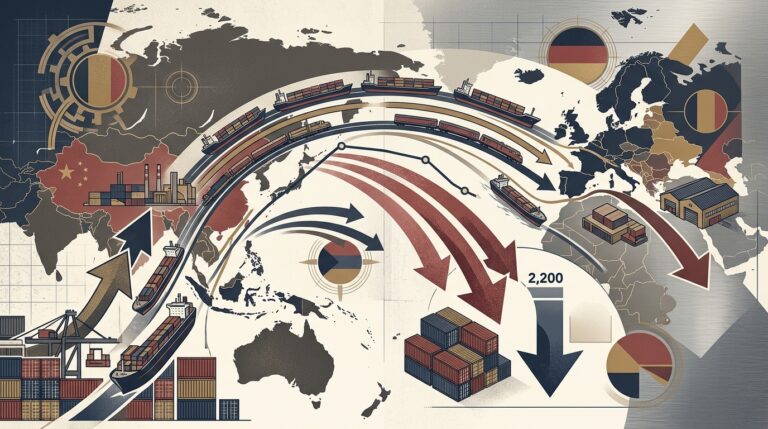
Asia-North Europe container spot rates have slid toward $2,199 per 20-foot equivalent unit (TEU), according to market reporting on carrier efforts to defend pricing. The decline is often read through familiar explanations: a seasonal lull after China’s Golden Week, weaker booking momentum, or expectations that some vessels may again use the Suez Canal.
Those factors matter, but they do not fully explain the scale of pressure on rates. The more important mechanism is the clash between longer sailing distances caused by Red Sea disruption and a record wave of new containership capacity. The Cape of Good Hope diversion absorbed ships for a time, but fleet growth has made that cushion less effective.
Detours Absorbed Capacity, But Not Enough
Houthi attacks in the Bab el-Mandeb strait pushed major ocean carriers away from the Red Sea and toward southern Africa. The route change materially lengthened voyages. Baseline chokepoint data from the U.S. Energy Information Administration shows a voyage taking 19 days via the Suez Canal versus 35 days around the Cape of Good Hope.
That 16-day difference tied up vessel capacity and helped support earlier rate strength. A ship spending more time at sea cannot be deployed as frequently, so the detour acted as an artificial brake on available supply.
The problem for carriers is that this brake is now being offset by the supply side. BIMCO industry data shows new containership deliveries pushing the global operating fleet above 30.4 million TEU. Scrapping has also remained limited, leaving older tonnage in service while the post-pandemic orderbook continues to feed new ships into the market.
Blank Sailings Are Losing Force
Carriers have tried to defend prices through blank sailings, the cancellation of scheduled voyages to remove capacity from the market. But those measures have not stopped the reported slide toward $2,199/TEU.
That suggests capacity management is struggling against two pressures at once: softer demand and a larger fleet. In this setting, cancelled sailings can slow the decline, but they may not be enough to restore pricing power if too many ships are chasing too little cargo.
Selective Suez Returns Could Add Pressure
Some operators are also testing a return to the Suez Canal. Liner schedules cited by The Loadstar included Ocean Network Express and the 8,110 TEU ONE Continuity on an Asia-North Europe loop.
The evidence points to selective trials, not a broad normalization of Red Sea routing. Still, the commercial logic is clear. A vessel that avoids the Cape route can shorten its voyage by the 16-day detour penalty, improving turnaround time and effectively releasing capacity back into a market already under supply pressure.
Security Risk Has Not Disappeared
The rate decline should not be read as proof that Middle East maritime risk has ended. The conflict that pushed carriers away from the Red Sea remains an active constraint. War-risk costs, escort availability, and carrier risk tolerance can still shape routing decisions.
The current market signal is narrower: even with unresolved security risk, fleet growth and weak demand appear strong enough to pull spot rates lower. That makes the Asia-Europe market less a story of geopolitical calm than of oversupply eroding the freight premium created by disruption.
Key Watchpoints for Q4 2026
Market participants tracking Asia-Europe freight costs should watch these developments:
- MSC’s October 19 Asia-Europe FAK Rate: The implementation of this Freight All Kinds rate will test whether the world’s largest carrier can establish a pricing floor or whether the slide below $2,200/TEU continues.
- Q3 Carrier Volume Disclosures: Earnings reports may clarify utilization levels for newly delivered ships and whether carriers are preparing to scrap older tonnage more aggressively.
- Operation Aspides Escort Registry: Updates from the European Union’s naval force may show whether the ONE Continuity transit remains an isolated case or becomes part of a broader escorted return to the Suez Canal.
***
*Disclaimer: This article is for informational purposes only and does not constitute financial, investment, or legal advice. Readers should consult licensed professionals before making trading or supply chain procurement decisions based on freight rate volatility.*
Want the full institutional-style PDF version? Enter your email for the free PDF.