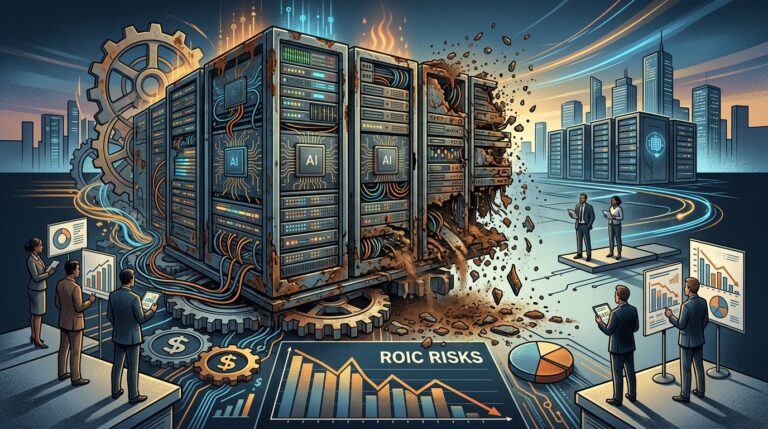
Big Tech’s artificial intelligence buildout is creating a widening gap between cash spent on infrastructure and the expenses recognized later through depreciation. That timing matters for Return on Invested Capital (ROIC): if servers become obsolete faster than expected, or if financing costs stay elevated, today’s margin strength could face pressure in the 2027-2028 period.
The issue is not simply whether AI demand grows. It is whether that growth converts into high-margin cash flow quickly enough to offset heavier capital spending, larger invested capital bases, and any acceleration in depreciation expense.
Why Server Useful Lives Matter
When a technology company buys servers, the full cost is not charged to earnings immediately. The equipment is capitalized and expensed over its estimated useful life.
Microsoft’s Form 10-K states that server and network equipment are depreciated over 6 years (official source). That accounting treatment spreads hardware costs across future periods, supporting reported operating margins relative to the cash already spent on infrastructure.
The sensitivity is the useful-life assumption. If AI hardware cycles shorten and servers need to be replaced in three or four years rather than over the disclosed 6-year schedule, annual depreciation would rise. That would reduce operating income even if revenue continues to expand. The accounting expense may catch up after the cash outlay has already occurred.
Financing Costs Add a Separate Pressure Point
Depreciation is only part of the ROIC question. The cost of capital also affects whether new infrastructure earns an adequate economic return.
The Federal Funds Target Range Upper Limit provides a baseline for the cost of money in the broader economy (official source). Corporate borrowing conditions are also reflected in the ICE BofA US Corporate Index Option-Adjusted Spread (official source).
Those indicators do not prove company-specific borrowing pressure by themselves. They do, however, define the macro backdrop for debt-funded infrastructure. If benchmark rates remain higher than historical averages or investment-grade spreads widen, new borrowing tied to data centers becomes more expensive. That raises the return hurdle for AI investments.
The ROIC Risk Scenario
A plausible downside path combines faster depreciation with higher financing costs. Under that scenario, hyperscalers would face rising annual depreciation from shorter server lives while also confronting a more demanding cost-of-capital environment for infrastructure spending.
For ROIC to hold up, AI-related revenue would need to scale with enough margin and speed to absorb both pressures. Microsoft’s Form 10-K disclosure on commercial remaining performance obligations provides one view into contracted revenue visibility (official source). But performance obligations reduce demand uncertainty only in part; they do not by themselves prove future margins, cash conversion, or returns on the incremental capital required.
Large capex programs can still be economically attractive, but the timing of cash outflows, depreciation recognition, and revenue conversion determines whether reported growth translates into durable returns.
What Is Still Unclear
Several inputs remain uncertain. The pace of AI silicon obsolescence is not yet settled. A 6-year useful life could remain appropriate if older servers continue to support less intensive workloads or inference use cases.
Sector-wide comparability is also limited. Companies do not always isolate AI-specific capital expenditures from broader cloud and data-center spending in a uniform way. Without consistent company-by-company capex, operating cash flow, useful-life, debt-maturity, and margin assumptions, the size of any future ROIC compression cannot be stated as a verified outcome.
The right conclusion is therefore conditional: AI infrastructure spending could pressure returns if asset lives shorten, utilization disappoints, financing costs rise, or revenue converts more slowly than expected. It is not yet evidence of an inevitable ROIC contraction.
What to Watch
Investors should focus on disclosures that test the thesis directly. Property and equipment footnotes in future hyperscaler 10-Q filings are important because any downward revision to server useful lives would bring depreciation pressure forward.
The Federal Reserve’s rate path and corporate option-adjusted spreads also matter because they influence the cost of debt-funded infrastructure. Finally, commercial backlog and remaining performance obligations should be evaluated alongside margins, timing, and required incremental capital, not treated as a stand-alone proof of future ROIC strength.
***
*Disclaimer: This article is for informational purposes only and does not constitute financial, investment, tax, or legal advice. Market conditions and accounting policies are subject to change. Readers should consult with a licensed financial professional before making any investment decisions.*
Want the full institutional-style PDF version? Enter your email for the free PDF.