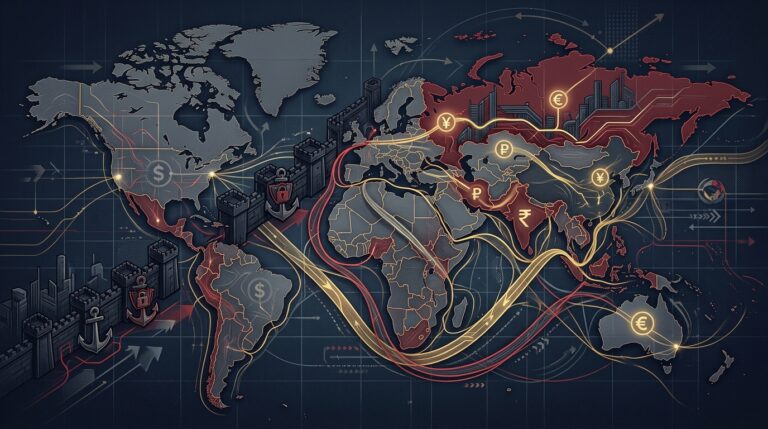
Alternative cross-border payment platforms and non-dollar settlement arrangements can reduce reliance on traditional correspondent banking. They do not, by themselves, remove the legal, customs, liquidity, and commercial constraints attached to sanctioned commodity trade.
That distinction matters because market discussion often compresses several separate issues into one claim: if money can move outside dollar rails, sanctioned trade can continue with limited exposure. The stronger conclusion is not supported. Payment architecture can change how settlement occurs, but secondary sanctions and tariff policies can still raise the legal cost of doing business with targeted flows.
Settlement Technology Is Only One Layer
Project mBridge shows why alternative rails deserve attention. The Bank for International Settlements describes mBridge as a multi-CBDC platform for real-time, peer-to-peer cross-border payments and foreign exchange transactions. The project uses the mBridge Ledger, a custom-built distributed ledger technology, and operates under a bespoke governance and legal framework rulebook (Bank for International Settlements).
The initiative reached its Minimum Viable Product stage after development by the BIS Innovation Hub, the Hong Kong Monetary Authority, the Bank of Thailand, the Digital Currency Institute of the People’s Bank of China, and the Central Bank of the United Arab Emirates. The Saudi Central Bank was onboarded in 2024 (Bank for International Settlements).
Those facts demonstrate technical progress. They do not demonstrate immunity from sanctions, customs measures, trade-finance constraints, or destination-market enforcement.
The Physical Cargo Still Faces the Border
A payment rail settles the financial leg of a transaction. It does not move hydrocarbons, agricultural products, or manufactured goods through a port.
That is the core weakness in claims that alternative settlement can bypass secondary pressure. If a destination market applies a tariff or customs measure to goods from a targeted origin, the enforcement point is the cargo entering the market. The authority at the border does not need to rely on the currency used in the invoice to impose customs treatment.
In that setting, changing the settlement rail may reduce exposure to dollar-clearing channels, but it does not change the origin of the goods, the destination of the cargo, or the legal treatment imposed at entry. For related coverage of payment screening and secondary sanctions risk, see Cross-Border Payment Screening Under Secondary Sanctions.
Legal Exposure Does Not End With Currency Choice
Secondary sanctions are often discussed through the lens of dollar clearing, but the risk is broader than the currency used for settlement. A financial institution, trader, shipper, insurer, or importer can still face consequences if the underlying activity falls within a sanctions framework.
That is why alternative rails should be viewed as a partial reduction in one channel of exposure, not a full shield. A multi-CBDC platform or local-currency arrangement may alter payment-message visibility and reduce dependence on correspondent banking. It does not erase the underlying compliance question: whether the parties, cargo, transaction, or destination-market treatment create sanctions or tariff risk.
The U.S. Treasury’s sanctions program information remains a central reference point for understanding how sanctions exposure is framed across programs (U.S. Treasury Office of Foreign Assets Control).
Liquidity and Convertibility Remain Commercial Constraints
Even when a transaction can settle outside the dollar system, exporters still have to manage what they receive. Dollar clearing offers deep liquidity and broad convertibility. Local-currency or alternative-currency settlement can leave exporters with balances that are harder to convert, deploy, or use for purchases from third countries.
That balance-sheet issue is not a technical bug in the payment rail. It is a commercial adoption constraint. Commodity exporters need settlement assets that can fund imports, service obligations, and move across global markets. If the settlement currency cannot be used at scale across trading partners, the transaction may solve one payment problem while creating another liquidity problem.
This is why the move of platforms such as mBridge to the Minimum Viable Product stage should be read carefully. It confirms that central banks are testing new settlement infrastructure. It does not prove that alternative rails can replace the liquidity and legal certainty required for large-scale commodity finance. For broader context, see Trade Finance Settlement Risk: Secondary Sanctions and Payment Finality.
What Would Change the Assessment
The key question is not whether alternative rails can process cross-border payments. They can. The harder question is whether banks, insurers, shippers, traders, importers, and exporters are willing to use them for flows that still face sanctions, customs, convertibility, and reputational risk.
The strongest indicators to watch are official changes to platform governance, sanctions-screening arrangements, participation by major central banks, and any policy shift that applies tariffs or sanctions to commodity flows regardless of payment currency. Until those issues are resolved, alternative payment rails may support limited settlement diversification, but they cannot be treated as a reliable bypass of secondary sanctions or punitive customs measures.
***
*Disclaimer: This article is for informational purposes only and does not constitute financial, legal, or tax advice. This article was researched and drafted with AI assistance. The geopolitical and regulatory environments discussed are subject to rapid change. Readers should consult licensed professionals before making any investment or compliance decisions.*
Want the full institutional-style PDF version? Enter your email for the free PDF.