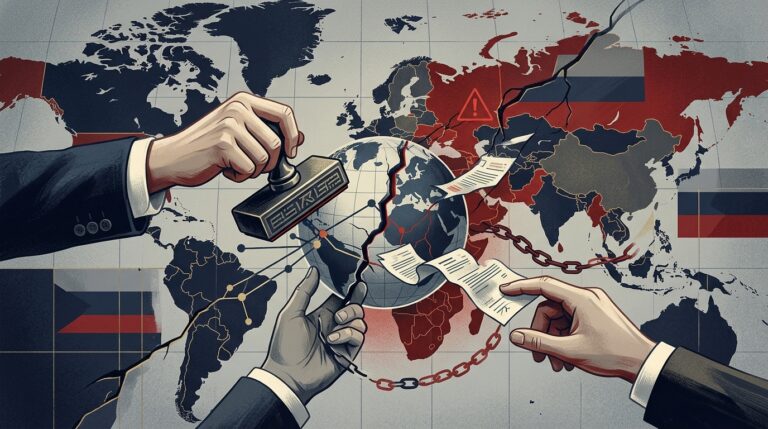
Global supply chains and commodity importers are testing whether non-dollar settlement systems can withstand regulatory pressure. The central problem is not only access to alternative financial messaging networks or local-currency clearing rails. It is whether the banks needed to process trade payments can accept the risk of being linked to global clearing systems while serving counterparties exposed to Western sanctions.
That makes secondary sanctions risk in trade finance a practical constraint, not just a geopolitical debate. Alternative rails may reduce reliance on some Western-controlled infrastructure in selected corridors, but they do not automatically protect banks, exporters, importers, or commodity buyers from sanctions exposure. As regulatory scrutiny tightens, cross-border trade finance can be pushed into a multi-tier intermediary structure that raises compliance burdens, slows settlement, and complicates liquidity planning.
How U.S. and EU Rules Target Intermediaries
U.S. sanctions policy has increasingly focused on foreign financial institutions that support restricted activity through cross-border payment channels. OFAC FAQ 1147 explains that Executive Order 14114 amended E.O. 14024 to authorize blocking sanctions and correspondent or payable-through account prohibitions against foreign financial institutions that facilitate significant transactions involving designated entities or Russia’s military-industrial base (U.S. Treasury OFAC).
Treasury enforcement also shows how settlement channels themselves can become part of the sanctions analysis. On September 14, 2026, the U.S. Treasury announced actions under Operation Economic Outcast involving VTB Bank and related financial settlement mechanisms. The release cited correspondent accounts and bilateral local-currency settlement channels used to circumvent sanctions (U.S. Treasury Press Release).
European restrictions are moving in a similar direction. Analysis of the Council Regulation measures accompanying the EU 21st sanctions package, adopted on July 23, 2026, describes expanded financial sector transaction bans affecting non-Russian third-country intermediaries. The same analysis says EU operators are prohibited from connecting to alternative financial messaging platforms such as SPFS (Global Trade and Sanctions Law).
The Friction Tax in Trade Finance
The policy debate is often framed as a contest between de-dollarization and Western financial dominance. That framing misses the operating reality for trade finance desks. Secondary sanctions risk does not need to produce a complete cutoff to disrupt payment flows. If major foreign commercial banks fear losing dollar correspondent access, they may narrow relationships, avoid exposed counterparties, or route transactions through smaller regional intermediaries.
That shift can create a friction tax across commodity and industrial supply chains. Payments may face more compliance review, more complex routing, greater counterparty uncertainty, and slower settlement. The result is not a clean alternative financial order, but a more fragmented payment environment in which firms must manage legal exposure alongside liquidity and working-capital pressure.
For corporate treasurers, secondary sanctions risk reshapes trade finance by turning routine clearing decisions into compliance-sensitive operational choices.
What Remains Unclear
Important limits remain. Public evidence does not establish the actual scale, durability, or transaction volume of alternative payment infrastructure such as SPFS or emerging local-currency rails. It is also unclear how far these systems can expand before participating institutions face greater correspondent-account risk.
The impact on legitimate, non-sanctioned Global South trade finance is also difficult to measure. Available sources support the conclusion that regulators are targeting sanctions circumvention channels, but they do not provide standardized data on compliance costs, settlement delays, liquidity effects, or counterparty refusal for corporate end-users operating through multi-tier intermediaries.
Assessing the Compliance Burden on Payment Intermediaries
When foreign commercial banks evaluate their cross-border payment channels, the threat of losing dollar correspondent access forces a reevaluation of counterparty relationships. Rather than facing a complete cutoff, the regulatory environment often pushes transactions into a multi-tier intermediary structure. This shift creates distinct operational pressures for institutions navigating alternative financial messaging networks.
Regulatory frameworks explicitly target these intermediary channels through several enforcement mechanisms:
- Under E.O. 14114, which amended E.O. 14024, institutions face correspondent or payable-through account prohibitions if they facilitate significant transactions connected to designated entities or Russia’s military-industrial base (U.S. Treasury OFAC).
- The U.S. Treasury’s Operation Economic Outcast, announced on September 14, 2026, demonstrated that bilateral local-currency settlement channels and correspondent accounts used for circumvention involving VTB Bank are subject to enforcement action (U.S. Treasury Press Release).
- The EU 21st sanctions package, adopted on July 23, 2026, prohibits European operators from connecting to alternative platforms like SPFS and expands transaction bans on non-Russian third-country intermediaries (Global Trade and Sanctions Law).
How Fragmented Clearing Impacts Corporate Liquidity
For commodity buyers and exporters, the push toward alternative local-currency clearing rails introduces a tangible friction tax. As major banks avoid exposed counterparties or route transactions through smaller regional intermediaries, routine clearing decisions become complex operational choices. Corporate treasurers must manage the resulting counterparty uncertainty and slower settlement times, which directly complicate working-capital pressure and liquidity planning.
While geopolitical debates often focus on de-dollarization, the immediate reality for trade finance desks is a highly fragmented payment environment. Firms operating across sanctions-sensitive corridors face increased compliance review and more complex routing. Furthermore, because public evidence does not establish the durability, scale, or transaction volume of alternative infrastructure like SPFS, corporate end-users lack standardized data on compliance costs and settlement delays.
This lack of visibility makes it difficult to measure the full impact on legitimate Global South trade finance. Supply chains are forced to absorb the friction of multi-tier intermediary structures without clear insight into how far these local-currency systems can expand before participating institutions face greater correspondent-account risk.
Watchpoints for Global Trade Finance
The key issue for trade finance desks is how regulators define and enforce exposure through intermediaries. Market participants should watch whether OFAC provides further guidance on what counts as significant transactions for foreign financial institutions under E.O. 14114.
They should also monitor implementation of the EU 21st sanctions package through late 2026, especially how European banks assess third-country correspondent relationships that may connect indirectly to prohibited messaging platforms such as SPFS. Understanding secondary sanctions risk in cross-border trade payments will remain part of supply chain risk management for firms operating across sanctions-sensitive corridors.
*Disclaimer: This article is for informational purposes only and does not constitute financial, legal, or tax advice. This article was researched and drafted with AI assistance. Readers should consult a licensed professional before making corporate finance or compliance decisions.*
Want the full institutional-style PDF version? Enter your email for the free PDF.