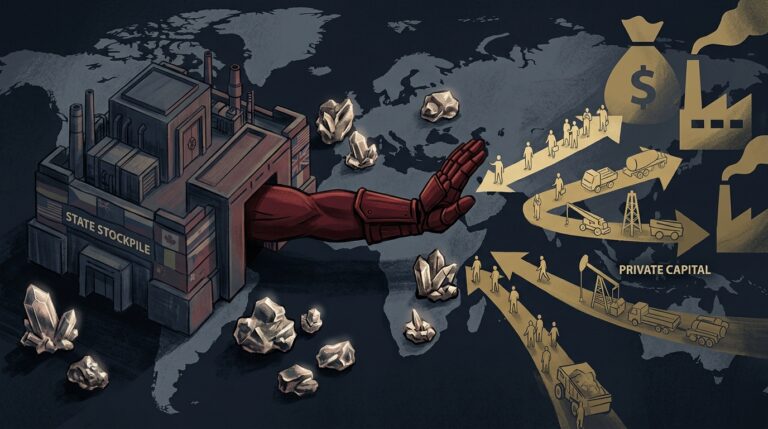
A fundamental paradox is unfolding in the global critical minerals market. While governments from Washington to Brussels commit billions to strategic stockpiling programs, the private capital needed to build new mines and refineries is retreating. Global private investment in the sector fell 9 percent in the 2025–2026 period, according to the International Energy Agency’s latest outlook TDI Sustainability IEA critical-minerals outlook summary.
This isn’t a simple market failure. Instead, the very structure of state interventions, designed to secure emergency supplies, is creating pricing and regulatory distortions that disincentivize the long-term private capital expenditure essential for a resilient supply chain. While public stockpiles offer a short-term buffer, they may inadvertently worsen the long-term structural vulnerability they aim to solve.
The Critical Minerals Investment Paradox
The scale of government action underscores the strategic urgency. The United States has launched Project Vault, a $12 billion public-private initiative to stockpile essential materials PIIE Project Vault policy brief. This move is a direct response to escalating supply chain risks, highlighted by China’s expanded export restrictions on key industrial inputs like rare earths, antimony, and germanium Xinhua critical-minerals export report. Yet, this flood of public money has failed to catalyze private investment.
The 9% decline in private capital flows reveals a deep disconnect TDI Sustainability IEA critical-minerals outlook summary. Private investors, who must underwrite projects with 10- to 20-year return horizons, see government stockpiling not as a safety net but as a source of profound market uncertainty.
How Public Stockpiling Distorts Private Investment
State intervention creates two primary frictions for private capital. First, it distorts price signals. A government entity acting as a massive buyer or seller of last resort can artificially cap price upside or create unpredictable price floors. This makes it nearly impossible for private developers to model future cash flows and secure project financing based on traditional supply-and-demand fundamentals Idea Farm critical-minerals outlook.
Second, it introduces regulatory risk. Programs like Project Vault propose using novel mechanisms such as “voluntary commercial subscription fees” from private industry to help fund the stockpile PIIE Project Vault policy brief. For a private company, this represents a potential off-balance-sheet liability with unclear terms, making it a significant deterrent for long-term capital commitment.
The Unsolved Refining Bottleneck
The investment gap is most acute in downstream processing and refining, not just upstream extraction. Stockpiling raw ore does little to reduce strategic dependency if the capacity to refine it into usable metals and chemicals remains highly concentrated abroad Council on Foreign Relations stockpile analysis. Building a new refinery is a multi-billion dollar, capital-intensive endeavor.
Private investors are hesitant to fund these projects when the government’s stockpile could, in a crisis, flood the market with material, depressing prices and rendering the new facility unprofitable. Without a clear and stable long-term market, private capital will continue to avoid the critical mid-stream segment of the supply chain.
What Remains Uncertain
Several key factors remain unclear. The precise terms of the private-sector partnership model for Project Vault have not been finalized, leaving the full extent of potential liabilities unknown. It is also difficult to fully separate the market impact of China’s export controls from the chilling effect of Western stockpiling policies.
Furthermore, the long-term commitment of allied nations to participate in U.S.-led supply chain initiatives versus developing their own independent stockpiles and refining capacities is a significant variable. A fragmented approach could lead to further market inefficiencies and competition for limited resources.
Next Watchpoint for Investors
The next critical signpost will be the finalization of Project Vault’s private-sector partnership terms, which the U.S. Department of Commerce is expected to release in the fourth quarter of 2026. This document will detail the specific pricing mechanisms, subscription liabilities, and drawdown rules for the stockpile. These terms will ultimately determine whether private capital sees the program as a stabilizing force or a prohibitive risk, shaping investment flows in the critical minerals sector for years to come.
*(Disclaimer: This article is for informational purposes only and does not constitute financial, legal, or tax advice. This article was researched and drafted with AI assistance. Market conditions are subject to change. Readers should consult with a licensed professional before making any investment decisions.)*
Want the full institutional-style PDF version? Enter your email for the free PDF.