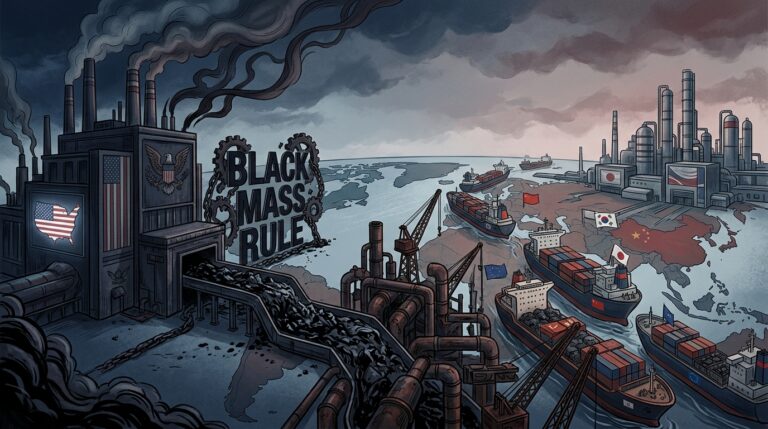
A new U.S. directive to keep critical battery materials onshore risks creating a severe domestic processing bottleneck, potentially depressing scrap prices and disrupting the recycling supply chain it intends to secure. While the policy successfully halts exports of processed battery scrap, the nation currently lacks the specialized refining capacity to handle the resulting domestic surplus.
The New Rule: A Domestic-First Mandate
Effective August 27, 2026, the U.S. Department of Commerce’s Bureau of Industry and Security (BIS) has mandated that all domestic sales of shredded lithium-ion battery scrap, known as “black mass,” and tungsten scrap must be allocated to domestic buyers Pillsbury black-mass export restrictions analysis. This temporary one-year order, issued under the authority of the Defense Production Act (DPA), is a direct response to a July 30, 2026, presidential determination that designated these materials as essential to national defense Forbes recycled critical-minerals export report.
The rule defines black mass as the material resulting from shredding lithium-ion batteries, which contains valuable cathode and anode materials like lithium, cobalt, and nickel Green Li-ion black-mass export-rule analysis. The directive’s goal is to secure these feedstocks for an emerging U.S. refining industry, insulating it from foreign competition, particularly from established processing hubs in Asia Benchmark Mineral Intelligence black-mass report.
The Refining Gap: A Structural Imbalance
The policy’s immediate challenge is a fundamental imbalance in the North American battery recycling infrastructure. The industry has ample mechanical shredding capacity—the “front half” of the process that produces black mass. However, it suffers from a critical shortage of operational commercial-scale hydrometallurgical refineries—the “back half” that chemically processes black mass to recover pure metals Electra Battery Materials black-mass rule statement.
This gap means that while the U.S. can generate large volumes of black mass, it cannot currently process it all domestically. By trapping this material within U.S. borders without sufficient downstream capacity, the rule transforms an intended supply-chain catalyst into a potential inventory choke point.
Market Impact: Price Pressure and Inventory Risk
With export markets now closed, U.S. battery shredders face a surge in domestic supply competing for a very limited number of domestic refining slots. This supply-demand mismatch is expected to exert downward pressure on domestic black mass prices, as recyclers are forced to offer discounts to secure processing agreements SMM black-mass export analysis. The situation could compress cash flow for recyclers and lead to stockpiling of unprocessed material.
This creates significant friction with established trade partners in Europe and Asia, who have historically been the primary buyers of U.S. black mass. Access to those markets is now contingent on securing case-by-case exemptions from the BIS, a process with unclear criteria and timelines Critical Minerals Bulletin black-mass export analysis.
Unintended Consequences and Workarounds
The directive’s specific focus on shredded scrap may also create structural workarounds. The rule restricts the export of black mass but does not cover whole, unprocessed end-of-life battery packs Auto Resource black-mass export-ban analysis. This could incentivize companies to bypass the domestic shredding process entirely and export whole battery assemblies, undermining the policy’s core objective of retaining critical minerals within the U.S.
The Watchpoint: A November Deadline
The key variable for market participants is how the government and industry will bridge this refining gap. The BIS has opened a 90-day public comment period on the temporary rule, which closes on November 4, 2026. Feedback from recyclers and refiners during this period will be critical in shaping potential adjustments, including the framework for temporary hardship exemptions needed to manage the inventory surplus until new domestic refining capacity comes online StockTitan / Electra black-mass rule update. The content of these submissions and any subsequent guidance from the Commerce Department are the next major catalysts for the U.S. battery recycling sector.
*Disclaimer: This article is for informational purposes only and does not constitute financial, legal, or tax advice. This article was researched and drafted with AI assistance. Readers should consult with a licensed professional before making any investment decisions.*
Want the full institutional-style PDF version? Enter your email for the free PDF.