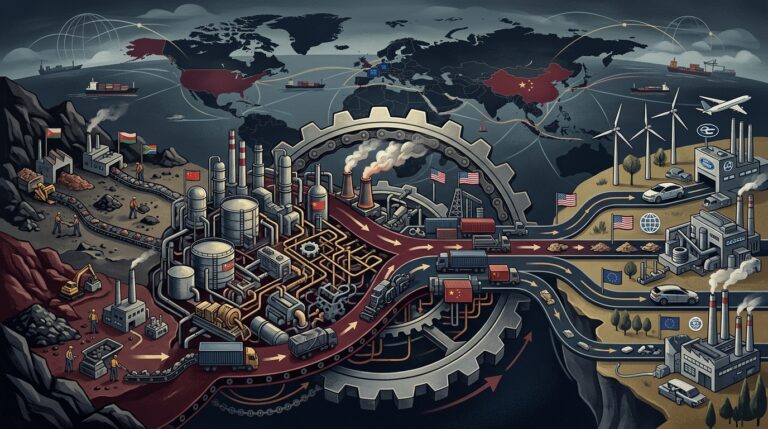
The Midstream Rare Earth Chokepoint
Global efforts to diversify rare earth supply chains are accelerating, but the most difficult constraint is not simply access to ore. The strategic pressure point sits further along the chain: chemical separation, refining, and sintered magnet fabrication.
Global rare earth oxide mine production reached 390,000 metric tons in 2025, according to the U.S. Geological Survey. Yet U.S. net import reliance still exceeds two-thirds of apparent consumption, underscoring the gap between mine output and secure industrial supply (U.S. Geological Survey).
That gap matters for emerging markets with rare earth deposits. Mining can create leverage only if it connects to commercially viable processing, environmental permitting, buyer offtake, and licensed technology. Without those links, resource-rich countries may risk locking themselves into an upstream role rather than building higher-value industrial capacity.
Vietnam and Malaysia Take Different Policy Paths
Emerging markets are using export rules to push foreign partners toward domestic processing, but the policy trade-offs are sharp.
Vietnam, whose audited national rare earth reserves were recently revised to 3.5 million metric tons (U.S. Geological Survey), has taken a restrictive approach. The country amended its Law on Geology and Minerals to classify rare earths as a National Strategic Asset. The amendment prohibits exports of raw rare earth minerals and requires international cooperation to focus on technology transfer, beneficiation, separation, and domestic deep processing (The Straits Times).
The policy aim is clear: keep more value inside the country and prevent extraction without local industrial development. The risk is also clear. If processing capacity, technology transfer, and capital do not arrive on workable terms, export restrictions can slow the very investment they are designed to attract.
Malaysia is weighing a more conditional route. As of August 2026, Malaysian government officials were considering limited exemptions from the raw rare earth export moratorium, tied to foreign investment commitments and midstream technology transfers (Caixin Global). That approach suggests concern that an absolute ban can become counterproductive if domestic processing capacity remains unavailable.
Why Export Bans Are Not Enough
A raw export ban can change bargaining power, but it cannot by itself create a refining sector. Rare earth separation depends on specialized hydrometallurgical capability, environmental controls, qualified operators, and reliable financing.
This is where the midstream trap appears. A government may control deposits and restrict raw exports, while buyers still need refined oxides, separated materials, and magnets rather than unprocessed feedstock. Without bankable processing projects, offtake agreements, and technology access, upstream assets can become commercially constrained instead of strategically powerful.
For Western buyers, the problem becomes a compliance and procurement challenge. Supply security depends on usable industrial inputs, not only access to mineral-bearing material.
What Remains Uncertain
Several important variables remain unresolved. It is not yet clear whether Western capital markets will finance midstream separation facilities in Southeast Asia without government-backed price guarantees to offset market volatility. Malaysia’s possible policy shift is still in deliberation, not enacted law, and the conditions for any export exemptions remain undefined.
Vietnam’s amended law sets a firm direction, but its practical impact will depend on whether foreign partners commit real processing technology and whether domestic facilities can move from policy ambition to operating capacity.
Watchpoints for Defense and Tech Supply Chains
For procurement officers and supply chain strategists, the key issue is whether emerging market rare earth policy produces processing capacity or only tighter control over raw material. Malaysia’s late 2026 legislative session will be a central test of whether conditional easing becomes official policy.
Vietnam should also be watched for joint venture announcements that explicitly include hydrometallurgical technology transfer, beneficiation, separation, and domestic deep processing. Those details will show whether its mineral law can attract the midstream capital and know-how needed to convert reserves into usable supply chain leverage.
Related Analysis
- Mineral Export Truce Masks $6.5T Midstream Supply Risk
- Critical Mineral Refining Margins Face Policy Hurdles
- US Defense Faces 2027 China Minerals Ban Reality Check
- China Rare Earth Export Controls Hit Defense Supply Chains
- EU Industrial Accelerator Act: EV Supply Chain Backdoor
Disclaimer: This article is for informational purposes only and does not constitute financial, investment, legal, or tax advice. This article was researched and drafted with AI assistance. Market conditions and geopolitical policies are subject to rapid change. Readers should consult with licensed professionals before making any investment or procurement decisions based on this information.
Want the full institutional-style PDF version? Enter your email for the free PDF.