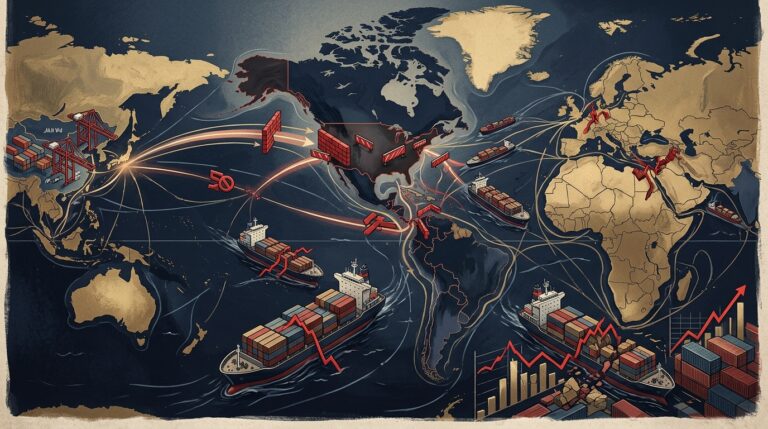
Geopolitical fragmentation is no longer only an episodic trade-dispute risk. For procurement teams and market participants, the central question is how maritime chokepoints, mineral-sourcing restrictions, and tariff changes may affect corporate margins, working capital, and supply-chain investment decisions.
Maritime Chokepoints and Ton-Mile Expansion
Logistical redundancy has become a more important part of global trade planning. IMF PortWatch provides live vessel transit and daily tonnage data for the Bab el-Mandeb Strait, a key route for trade moving between Asia, Europe, and surrounding markets (IMF PortWatch).
UNCTAD’s maritime transport analysis shows that longer-distance routing can cause ton-mile demand to rise faster than underlying cargo volume when vessels divert around disrupted passages (UNCTAD). For companies, that matters because goods spending more time on the water can tie up working capital and increase the need for inventory buffers. The evidence supports a clear risk channel: route disruption can absorb shipping capacity even when the volume of goods being moved does not rise at the same pace.
Tariff Rewirings and Nearshoring Realities
Trade policy is adding another layer of cost and planning uncertainty. The Office of the United States Trade Representative detailed final determinations on Section 301 tariff changes across strategic clean-tech, battery, and semiconductor categories (USTR%20(FINAL).pdf)).
U.S. Census Bureau goods-trade rankings also show Mexico and Canada ahead of mainland China in the cited annual data (U.S. Census Bureau). That ranking does not, by itself, prove a complete relocation of supply chains. It does, however, align with the broader corporate need to evaluate North American sourcing, supplier qualification, and production geography. Related material-sourcing pressure is also visible in the discussion of how Critical Minerals Export Controls Hit Supply Chains.
Margin Pressure and Capital Allocation
Longer transit routes and tariff changes can pressure margins through several connected mechanisms: higher logistics exposure, larger inventory buffers, and added compliance or sourcing costs. The shift from “Just-in-Time” toward more resilient inventory models may increase carrying costs, especially where financing conditions make working capital more expensive.
The margin effect is likely to vary by company. Firms with concentrated supplier bases, limited pricing power, or single-geography intermediate dependencies may face greater pressure. Firms with more flexible supplier networks may be better positioned to absorb disruption, but redundancy usually requires upfront spending. That can raise the hurdle for supply-chain investment and may weigh on Return on Invested Capital (ROIC) before benefits are visible.
Limits to the Evidence
The exact pass-through rate from logistics and tariff costs to end consumers remains uncertain. The cited trade and policy sources support the existence of route, tariff, and trade-partner risks, but they do not provide company-level margin outcomes. Any forecast for corporate margin compression therefore depends on firm-specific pricing power, contract terms, inventory strategy, and supplier flexibility.
The duration of Bab el-Mandeb disruptions also remains difficult to predict from the available data. That leaves uncertainty around when freight normalization could reduce pressure on inventory planning and shipping capacity.
Next Watchpoints for Investors
Investors should watch Q3 2026 corporate earnings commentary for discussion of inventory carrying costs, working capital, supplier qualification, and tariff exposure. The USTR tariff rollout for semiconductor-related categories is another key policy marker for assessing compliance burdens in technology hardware supply chains.
***
*Disclaimer: This article is for informational purposes only and does not constitute financial, legal, or tax advice. This article was researched and drafted with AI assistance. Readers should consult a licensed professional before making investment decisions.*
Want the full institutional-style PDF version? Enter your email for the free PDF.