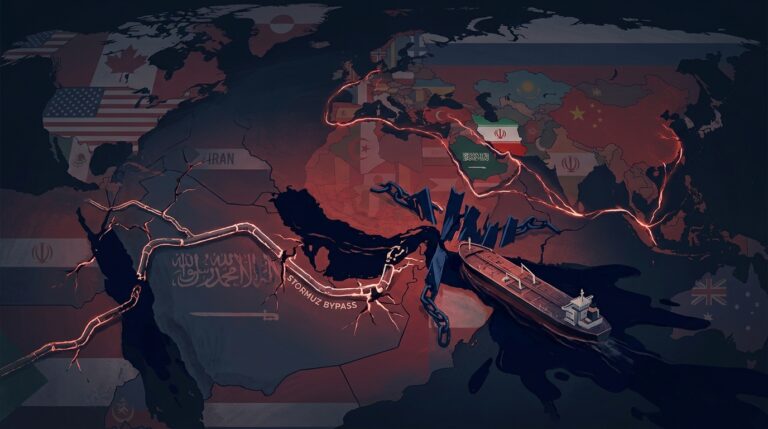
The Illusion of Seamless Rerouting
The Strait of Hormuz remains the global economy’s most critical energy artery, moving 20.9 million barrels per day (mb/d) of petroleum liquids in the first half of 2025, a slight increase from 20.7 mb/d in 2024 (U.S. Energy Information Administration).
When geopolitical tensions spike in the Persian Gulf, market commentary frequently points to overland pipelines in Saudi Arabia and the United Arab Emirates as a structural safety valve. The prevailing assumption is that these routes can seamlessly divert crude away from maritime threats, insulating global markets from a total supply shock.
This headline-driven view misprices physical reality. While overland pipelines provide a tactical buffer, their actual net spare bypass capacity is limited to just 2.6 to 4.7 mb/d (U.S. Energy Information Administration). This mathematical ceiling leaves more than 75 percent of Gulf petroleum liquids entirely exposed to a maritime halt.
Nameplate Capacity vs. Physical Throughput
The discrepancy between market expectations and physical flow stems from confusing design specifications with available export capacity.
Saudi Arabia’s East-West Pipeline, known as Petroline, has a baseline design capacity of 5.0 mb/d, which can theoretically be expanded to 7.0 mb/d. Concurrently, the UAE operates the Habshan-Fujairah pipeline with a capacity of 1.5 mb/d (U.S. Energy Information Administration).
However, nominal capacity does not equal immediate seaborne clearing capacity. Pushing these systems to their maximum limits involves severe technical constraints. Ramping up throughput requires specific drag-reducing agents (DRAs) and faces strict conversion timeline hurdles for crude diversion (Baker Institute). Markets pricing in an immediate 8.5 mb/d diversion are ignoring the operational friction required to physically move and load that volume.
Security Vulnerabilities of Overland Corridors
Even if physical bottlenecks could be instantly resolved, the infrastructure itself is not immune to the regional conflicts that would trigger a Hormuz closure.
Overland pumping infrastructure carries systemic security vulnerabilities. Historical analysis of chokepoint interdependencies shows that these pipeline networks are highly exposed to asymmetric drone and missile strikes (Council on Foreign Relations).
Pumping stations serve as particularly critical nodes. Hardening these facilities against attack is a complex requirement, and any damage to them severely limits the logistics of pipeline crude diversion (Baker Institute). A threat environment severe enough to close the Strait of Hormuz would likely involve geopolitical escalation paths that simultaneously target these overland alternatives, neutralizing the bypass strategy entirely (Council on Foreign Relations).
Market Implications of an Unhedged Supply Shock
If the Strait of Hormuz faces a sustained disruption, the math dictates a severe physical supply shock rather than a mere logistical rerouting.
With a maximum of 4.7 mb/d of spare pipeline capacity available to bypass the strait, the global market would instantly lose access to roughly 16 mb/d of crude and refined products. This structural deficit cannot be solved by simply turning up the pressure on Petroline or the Habshan-Fujairah systems. The technical limits of pipeline logistics and the vulnerability of pumping stations mean that the “pipeline put” is largely an illusion for the broader market.
Key Watchpoints for Energy Markets
Investors and policy observers tracking Middle Eastern energy risks should monitor specific operational and geopolitical indicators rather than relying on nominal pipeline capacities.
- DRA Stockpiles and Procurement: Monitor official procurement data regarding drag-reducing agents, which are mandatory for pushing pipelines toward their maximum expansion limits.
- Infrastructure Hardening: Track capital expenditure announcements related to the physical security and hardening of pumping stations along the Petroline and Habshan-Fujairah routes.
- Asymmetric Escalation Triggers: Watch for shifts in warfare tactics, specifically drone or missile deployments targeting interconnected energy transit systems, which serve as early indicators of broader chokepoint threats.
Disclaimer: This article is for informational purposes only and does not constitute financial, legal, or investment advice. This article was researched and drafted with AI assistance. Geopolitical events and commodity markets are subject to high uncertainty. Readers should consult licensed professionals before making trading or investment decisions based on geopolitical risk assessments.
Want the full institutional-style PDF version? Enter your email for the free PDF.