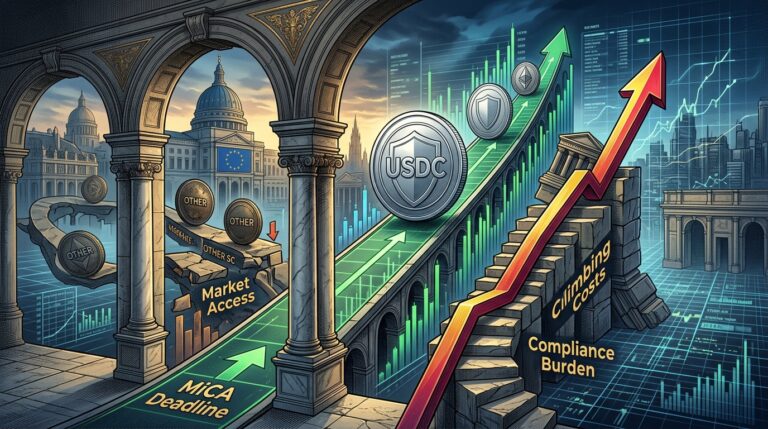
*A statutory transition is ending across the EU. From mid-2026, every stablecoin issuer serving European users must meet MiCA’s full authorization bar — and only a handful already do.*
The Markets in Crypto-Assets Regulation (MiCA) reaches full EU-wide application in mid-2026. National transitional periods that let some issuers operate under local rules are closing, and there is no further grace period beyond them (European Securities and Markets Authority, ESMA stablecoin guidance). For stablecoin issuers, the practical effect is binary: be authorized under MiCA, or stop serving EU residents.
Who Is Already Compliant
Of the ten largest stablecoins by market cap, only USD Coin (USDC) is MiCA-compliant as of early 2026, with EURC also authorized under the framework (Circle EU stablecoin disclosures). That narrow field matters because the regulation ties a stablecoin’s legal status in the EU directly to its issuer’s authorization, not to its liquidity or trading volume.
Issuers that built euro-denominated or dollar-denominated products without an EU authorization path now face a choice: acquire a licensed entity, partner with one, or exit the European market. Neither route is cheap.
What the Compliance Bar Actually Costs
MiCA imposes a dual-licensing structure — authorization as either an e-money institution or a credit institution, plus the crypto-asset service provider (CASP) registration — that raises both fixed and ongoing cost. Analysts tracking the regime estimate potential penalties above €540 million for serious breaches (MiCA enforcement commentary, Q1 2026), which reframes compliance from a paperwork exercise into a balance-sheet item.
The cost layers stack:
- Authorization spend — legal, audit, and capital buffers required before launch
- Ongoing supervision — periodic reporting and reserve attestation
- Banking rails — segregated reserve custody, typically with EU-regulated institutions
Smaller issuers that competed on yield or speed now carry a cost base they were not built to absorb.
Why USDC Gains and Others Retreat
USDC’s early authorization means it can keep serving EU users while competitors pause or pull listings. That advantage is not just market share — it is the ability to keep integrations with EU exchanges, wallets, and payment rails intact while rivals re-architect.
The trade-off is margin. Meeting MiCA’s reserve and disclosure rules is more expensive than operating outside it, so the issuers that win EU access pay a structural cost for the privilege. Circle’s own EU disclosures frame this as a feature; for smaller competitors it is a moat they cannot cross.
What the Evidence Does Not Prove
This analysis covers the regulatory and cost structure as documented through early 2026. It does not model individual issuer financials, and the exact reserve-composition rules continue to be refined by ESMA and national competent authorities. Readers should treat any specific compliance-cost figure circulating in secondary commentary as unconfirmed until the relevant issuer publishes it in a primary filing.
The Short Answer
MiCA’s mid-2026 full application turns stablecoin access in the EU into a licensing game with a high floor. USDC is positioned to hold and extend its lead; everyone else pays more or leaves. For anyone building or investing around European stablecoin flows, the question is no longer whether the rules exist, but whether a given issuer can afford to comply.
*This article is informational and does not constitute investment, legal, or regulatory advice. Consult a qualified professional before making decisions.*
Get This Report as a PDF
Enter your email to receive the full analysis report as a PDF.