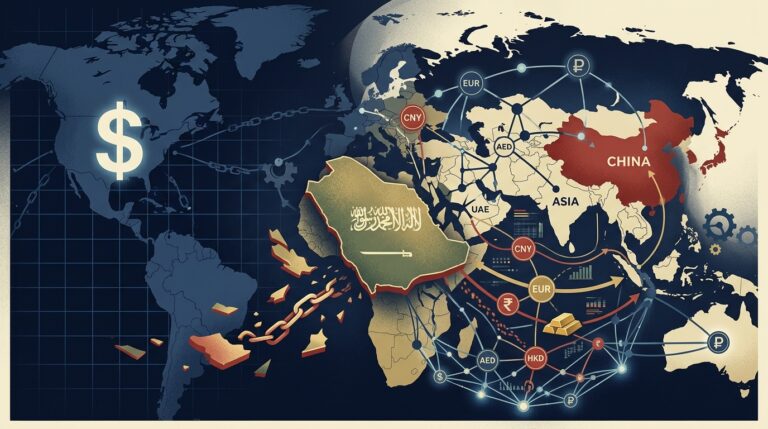
Media reports in September 2026 said the Saudi Central Bank had withdrawn from Project mBridge, the multi-central bank digital currency platform. Without a direct public confirmation from the Saudi Central Bank or the Bank for International Settlements, the reported move should be treated as a significant signal rather than a fully settled official record.
The broader question is not whether non-dollar settlement has stopped. It is whether highly visible multilateral CBDC rails can carry politically sensitive trade finance when sanctions exposure and sovereign signaling risks remain acute. On that reading, the reported Saudi shift points less to retreat than to migration: away from exposed shared ledgers and toward more insulated bilateral clearing channels.
Shared-Ledger Exposure
Project mBridge moved from the Bank for International Settlements Innovation Hub to its founding central banks, with a bespoke governance structure and formal participation framework managed by those monetary authorities (official source).
The platform reached its minimum viable product phase through validating nodes operated by participating central banks. That design can improve cross-border clearing efficiency, but it also makes participation more visible. For monetary authorities trying to preserve flexibility across competing trade, currency, and sanctions relationships, visibility itself becomes a risk.
Bilateral Channels Gain Strategic Appeal
As the Saudi mBridge exit tests CBDC trade finance limits, the energy-settlement story appears to be fragmenting rather than ending. Policy analysis of competing cross-border payment platforms highlights the limits of multi-CBDC shared-ledger models under current U.S. sanctions pressure (official source).
That distinction matters. A multilateral CBDC network depends on visible institutional participation, shared technical governance, and identifiable settlement nodes. Bilateral correspondent loops and alternative financial messaging arrangements can reduce that visibility, even if they do not remove legal, liquidity, or enforcement risk.
Sanctions Risk Remains the Core Constraint
Official U.S. congressional research has examined Chinese financial infrastructure and non-SWIFT payment arrangements in the context of sanctions and export-control evasion (official source). That does not mean every non-dollar rail is designed to evade sanctions. It does mean payment architecture is now part of geoeconomic risk assessment.
The Saudi mBridge exit: trade finance fragmentation risks capture the central dilemma for sovereign swing producers. Alternative settlement rails may reduce dependence on dollar-clearing choke points, but more formal and visible systems can also attract greater scrutiny. The result is a preference for channels that preserve optionality while limiting public exposure.
What Remains Unclear
The internal rationale for the reported Saudi withdrawal has not been officially published by the Saudi Central Bank. Market discussion has linked the issue to sanctions pressure, but that motive remains interpretive unless attributed to named reporting or official statements.
The scale of hydrocarbon trade moving into bilateral non-dollar channels is also opaque. Without transparent ledger data or official disclosure, the liquidity flowing through these arrangements cannot be definitively measured.
Watchpoints
For observers tracking how the Saudi mBridge exit tests CBDC commodity trade finance, the next signals are likely to come from bilateral actions rather than multilateral announcements.
Relevant indicators include bilateral swap activations between central banks, Gulf participation in alternative interbank payment systems, the governance evolution of mBridge-linked commercial entities, and any U.S. Treasury advisories addressing non-SWIFT financial messaging architectures.
***
*Disclaimer: This article is for informational purposes only and does not constitute financial, legal, or tax advice. This article was researched and drafted with AI assistance. Readers should consult licensed professionals before making investment decisions. MarketPilotDaily does not guarantee future outcomes or specific market movements.*
Want the full institutional-style PDF version? Enter your email for the free PDF.