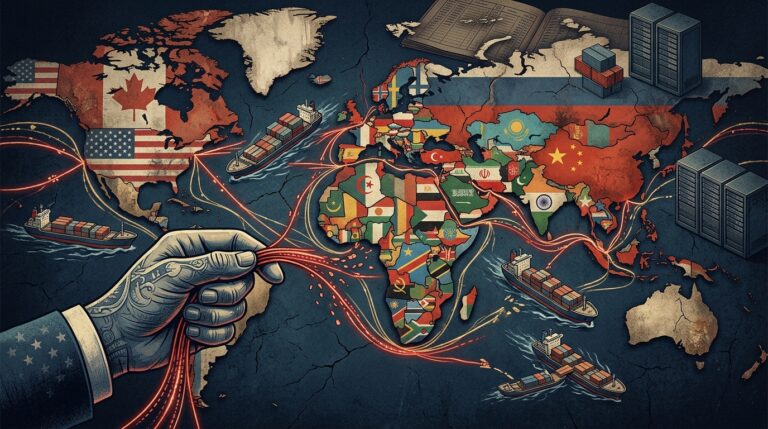
The U.S. Treasury’s September 2026 rollout of Operation Economic Outcast has sharpened the compliance risk around secondary sanctions. The central pressure point is not only the transaction itself, but the correspondent-banking infrastructure that links third-party commercial banks to global dollar clearing. For lenders active in emerging-market trade finance, that makes sanctions exposure harder to isolate inside nominally non-dollar flows.
Enforcement Moves From Transactions To Gateways
The U.S. Department of the Treasury designated VTB Bank PJSC under Executive Order 13902 on September 14, 2026, as part of Operation Economic Outcast (official U.S. Treasury release). The action placed secondary sanctions risk for foreign financial institutions at the center of the enforcement message.
The practical effect is a broader risk calculation for commercial banks. A lender that facilitates restricted activity can face consequences beyond a single blocked transaction, including potential pressure on its access to the U.S. financial system. That incentive pushes trade-finance desks toward tighter counterparty screening, narrower risk appetite, and more conservative documentation standards. The same pressure is visible in related coverage of how VTB and crypto restrictions have affected trade-risk calculations.
Correspondent Banking Becomes The Leverage Point
The enforcement picture extends beyond direct designations. Legal analysis from Sullivan & Cromwell says recent FinCEN Section 311 notices of proposed rulemaking targeted regional correspondent-banking branches and intermediary clearing channels. The analysis describes an August 28, 2026 action involving UAE branches of Banque Misr and U.S. correspondent-banking access (Sullivan & Cromwell analysis).
That distinction matters. Proposed rulemaking is not the same as a completed market-wide shutdown, but it can still alter bank behavior before final implementation. Banks in intermediary hubs must weigh the revenue from regional trade finance against the risk that a correspondent relationship becomes legally or commercially untenable.
Maritime Enforcement Adds A Physical Trade Constraint
Financial restrictions are also intersecting with maritime enforcement. The European External Action Service described an August 2026 policy framework tied to the 20th and 21st sanctions packages, including an EEAS Shadow Fleet Coordinator, maritime flag-verification boardings, and naval operations such as IRINI and Atalanta (EEAS policy framework).
For trade finance, the relevance is the combined effect of payment risk and logistics risk. When banks, insurers, shipping services, and compliance teams all apply tighter controls to the same trade corridor, even lawful transactions can face higher documentation burdens and longer approval paths. That is the channel through which secondary sanctions can reshape payment behavior without requiring every transaction to be directly prohibited. Related analysis has tracked how China-Russia trade payments have moved toward higher-friction settlement channels.
Alternative Payment Rails Remain Partial Workarounds
Non-dollar invoicing can reduce some exposure, but it does not automatically remove sanctions risk. The 18th BRICS Summit New Delhi Declaration outlined workstreams for the BRICS Payment Task Force, including fast payment system linkages and messaging interoperability. NCFA Canada’s documentation describes these efforts as part of a broader push toward local-currency settlement and cross-border payment alternatives (NCFA Canada documentation).
The limitation is operational. Fragmented local-currency clearing can help counterparties avoid some dollar-settlement dependencies, but it does not by itself solve screening, interoperability, liquidity, or legal-risk problems. For commercial banks, alternative rails are therefore best understood as partial risk-management tools rather than full substitutes for established correspondent networks.
What Trade Desks Should Watch
The key issue now is whether proposed correspondent-banking restrictions become durable operating constraints. If access to U.S. correspondent accounts is narrowed for exposed intermediaries, trade-finance desks may respond by tightening client eligibility, requiring more sanctions documentation, or routing transactions through less efficient settlement paths.
The article’s evidence supports a risk-channel analysis rather than a quantified claim about market-wide repricing. The clearest conclusion is that secondary sanctions risk is moving deeper into the mechanics of trade finance: correspondent access, maritime services, payment messaging, and counterparty due diligence are increasingly part of the same compliance calculation.
*Disclaimer: This article is for informational purposes only and does not constitute financial, legal, or tax advice. This article was researched and drafted with AI assistance. Readers should consult licensed professionals before making investment or compliance decisions.*
Want the full institutional-style PDF version? Enter your email for the free PDF.