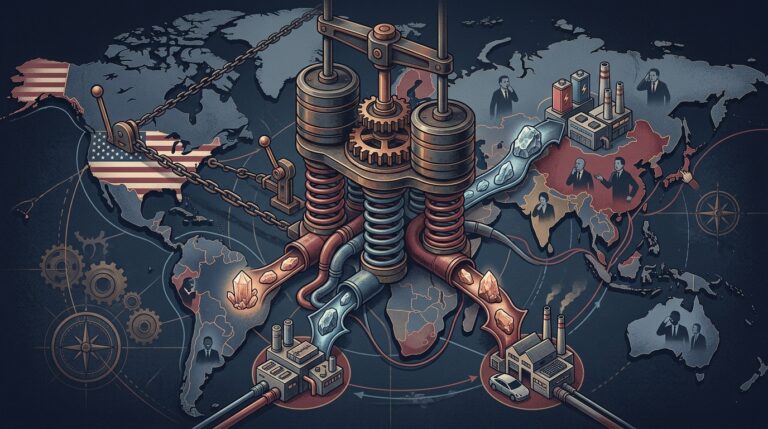
A new U.S.-led critical mineral trade policy, designed to secure supply chains, is creating an immediate structural challenge for the very industries it aims to support. While recently announced price floors and independent benchmarks protect upstream miners from state-sponsored price suppression, they also impose a significant cost burden on downstream American manufacturers in the automotive, aerospace, and energy sectors. The policy effectively creates a national security premium on essential inputs without resolving the critical midstream processing bottleneck, potentially squeezing corporate margins and complicating the green energy transition.
The New Critical Mineral Trade Policy Framework
In early August 2026, Washington formalized a new strategy to reshape the global trade in critical minerals. The U.S. Treasury and the Office of the U.S. Trade Representative (USTR) officially endorsed new pricing benchmarks from S&P Global for key minerals (https://home.treasury.gov/news/press-releases/sb0600, https://ustr.gov/about/policy-offices/press-office/press-releases/2026/august/ambassador-greer-issues-statement-welcoming-sp-globals-release-critical-minerals-pricing-benchmarks). This was coupled with a presidential proclamation under Section 232, establishing the basis for minimum import prices on these materials, citing national security White House critical-minerals investment fact sheet.
The stated goal is to build a plurilateral and preferential trade zone with allies, insulating them from anticompetitive practices Voice of America critical-minerals trade-zone analysis. This builds on action plans previously announced with the European Union and Japan to coordinate on supply chain security (https://ustr.gov/about/policy-offices/press-office/press-releases/2026/april/ambassador-jamieson-greer-announces-united-states-european-union-action-plan-critical-minerals, https://ustr.gov/about/policy-offices/press-office/press-releases/2026/march/ambassador-jamieson-greer-announces-us-japan-action-plan-critical-minerals). The policy aims to ensure that allied mining operations remain economically viable.
Upstream Protection, Downstream Pain
This new trade policy directly benefits upstream mining companies by establishing a price floor, shielding them from artificially low prices. However, this protection comes at a cost for downstream industries. Manufacturers are now expected to pay a premium for critical minerals sourced from allied nations Oregon Group critical-minerals premium analysis.
This creates a structural wedge between protected raw material producers and margin-constrained manufacturers. For companies in the electric vehicle, battery, and defense sectors, this translates to higher, less flexible input costs. The core issue is that there is no guaranteed mechanism for these companies to pass the increased costs on to consumers, leading to potential margin compression. This policy shift fundamentally reshapes the cost structure of critical supply chains EY critical-minerals trade-policy analysis.
The Unresolved Midstream Bottleneck
The administration’s critical mineral trade policy focuses heavily on extraction but largely sidesteps the most significant chokepoint: midstream processing and refining. Global trade data shows that while mining is geographically diverse, the conversion of raw ore into usable, high-purity materials remains highly concentrated UNCTAD Global Trade Update.
By implementing price floors without a corresponding surge in allied processing capacity, the policy risks inflating the cost of raw materials that must still be sent to non-allied nations for refining. This dynamic does little to reduce overall supply chain vulnerability. Recent executive orders aim to spur domestic investment White House critical-materials supply-chain order, but building new smelters and refineries is a capital-intensive process that takes years Pillsbury critical-minerals Project Vault analysis.
What Remains Uncertain in This New Policy
Several key questions about this critical mineral trade policy remain unanswered. It is not yet clear how non-aligned trading partners will react or whether they will implement retaliatory measures. The full adoption and enforcement of these price floors by partners in the EU and Japan, despite joint action plans Braumiller Law U.S.-EU critical minerals analysis, is also not guaranteed.
Furthermore, the specific mechanisms for monitoring and enforcing the price floors, particularly against transshipment through third countries, have not been detailed. The most significant uncertainty is whether private and public investment can build out the necessary midstream infrastructure before the higher input costs cause significant damage to the competitiveness of U.S. and allied downstream manufacturers Interos critical-minerals executive-order analysis.
Next Watchpoint for Critical Mineral Trade Policy
The next major development to watch is the OECD ministerial meeting in the fourth quarter of 2026, where the formal text of the proposed Agreement on Trade in Critical Minerals (ATCM) is expected to be negotiated. Market participants should also monitor the upcoming third-quarter earnings calls from major automotive, aerospace, and battery manufacturers for specific commentary on input cost pressures and any announced adjustments to their supply chain strategies Meltwater critical-minerals newsletter.
—
*This article is for informational purposes only and does not constitute financial, legal, or tax advice. This article was researched and drafted with AI assistance. Market conditions are dynamic. Readers should consult with a qualified professional before making any investment decisions.*
Want the full institutional-style PDF version? Enter your email for the free PDF.