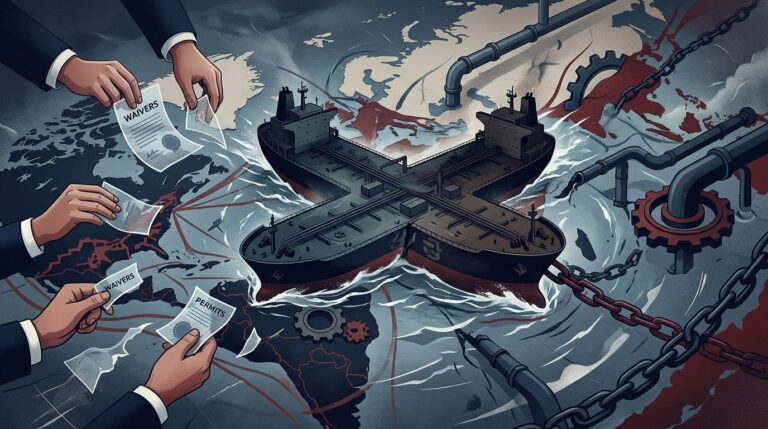
As global maritime logistics face unprecedented bottlenecks, policymakers in Washington are exploring unconventional levers to ease the pressure. The latest proposal involves bringing blacklisted vessels back into the mainstream market. However, the assumption that regulatory waivers will automatically inject usable tonnage into global energy routes overlooks the complex mechanics of maritime insurance and physical chokepoints.
The U.S. Treasury Deliberation on Tanker Waivers
The core of the current policy debate centers on utilizing the so-called “shadow fleet” to alleviate capacity constraints. Speaking at the World Petroleum Congress, U.S. Energy Secretary Chris Wright confirmed that there are active U.S. deliberations to relieve shadow fleet vessel sanctions in an effort to alleviate high freight rates (Ukrinform).
The proposed mechanism would involve administrative action from Washington. Specifically, U.S. authorities are considering allowing sanctioned tankers to transport non-sanctioned crude via Treasury licenses, a move explicitly aimed at lowering record-high freight rates (Safety4Sea).
On paper, this approach treats the freight crisis as a simple volume equation: if more hulls are legally permitted to carry standard cargo, the increased supply of vessels should theoretically drive down charter costs. Yet, the maritime shipping market does not operate on U.S. Treasury licenses alone.
The European Maritime Insurance Bottleneck
The primary friction point for integrating dark fleet vessels into mainstream logistics is liability coverage. Even if the U.S. Treasury grants a license, these vessels face persistent legal compliance barriers, most notably the ongoing European Union and United Kingdom maritime insurance restrictions on dark fleet hulls (Meduza).
The global maritime insurance market is heavily concentrated in London and Europe, where Protection and Indemnity (P&I) Clubs provide the standard liability coverage required by major ports, canal authorities, and mainstream commodity buyers. A U.S. Office of Foreign Assets Control (OFAC) waiver does not automatically compel a UK-based P&I Club to underwrite a vessel that has previously operated outside standard safety and compliance frameworks.
Without this top-tier insurance, these vessels remain effectively barred from entering key global ports or transiting heavily regulated waterways, regardless of their U.S. legal status. This compliance friction means that a U.S. waiver may only shift the bottleneck from Washington to London, rather than freeing up the vessels for immediate global deployment.
Physical Rerouting and Transshipment Realities
Beyond the legal and insurance hurdles, the physical flow of global energy has fundamentally shifted, altering where and how vessels are utilized. The current freight rate environment is heavily influenced by these geographic adjustments.
Recent Kpler tanker tracking data confirms that regional flows have reached over 24 million barrels per day (bpd), with the cross-country pipeline export share rising to roughly 40% (Finance Biggo). This data also highlights significant transshipment route adjustments off the coast of Oman.
These metrics indicate that the market is already adapting to chokepoints by utilizing overland pipelines and complex ship-to-ship transfers in safe waters. Adding formerly sanctioned vessels to this mix does not resolve the underlying geographic risks that are forcing these longer, more complex, and more expensive routing adjustments in the first place.
Scenarios for Maritime Energy Costs
If the U.S. proceeds with granting Treasury licenses to shadow fleet vessels, the market impact is likely to be highly segmented.
In a base-case scenario, these newly licensed vessels may be restricted to specific, lower-compliance regional trades where buyers and port authorities are willing to accept alternative, non-Western insurance. This could marginally free up standard, fully insured vessels for mainstream routes. However, because the newly licensed ships cannot seamlessly replace standard vessels in highly regulated European or Asian ports, the downward pressure on global benchmark freight rates would likely be muted.
The structural drivers of high delivered oil costs—longer voyage distances due to geopolitical avoidance zones and the high cost of standard P&I insurance—remain intact. Therefore, expectations that a stroke of a pen in Washington will rapidly normalize global shipping costs appear overly optimistic.
Key Watchpoints for Energy Logistics
For market participants tracking the intersection of sanctions policy and freight costs, the focus should move beyond the initial U.S. policy announcements. The practical impact will be determined by secondary regulatory and physical data points:
- U.S. Treasury/OFAC Licensing Terms: Watch for the specific conditions attached to any official waivers, particularly regarding mandatory U.S. Treasury licensing procedures and whether they require specific safety or ownership disclosures.
- UK/EU P&I Club Guidance: Monitor statements from European maritime insurance bodies regarding their willingness to underwrite formerly sanctioned hulls. Without their participation, the U.S. waivers lack practical utility for mainstream routes.
- Kpler Transshipment Data: Track the volume of transshipment route adjustments off Oman. A decrease in these complex transfers would be a stronger signal of normalizing logistics than the raw number of vessels granted U.S. waivers.
Disclaimer: This article is for informational purposes only and does not constitute financial, legal, or investment advice. This article was researched and drafted with AI assistance. Market conditions and regulatory frameworks are subject to rapid change. Readers should consult licensed professionals before making any trading or investment decisions based on geopolitical or macroeconomic developments.
Want the full institutional-style PDF version? Enter your email for the free PDF.