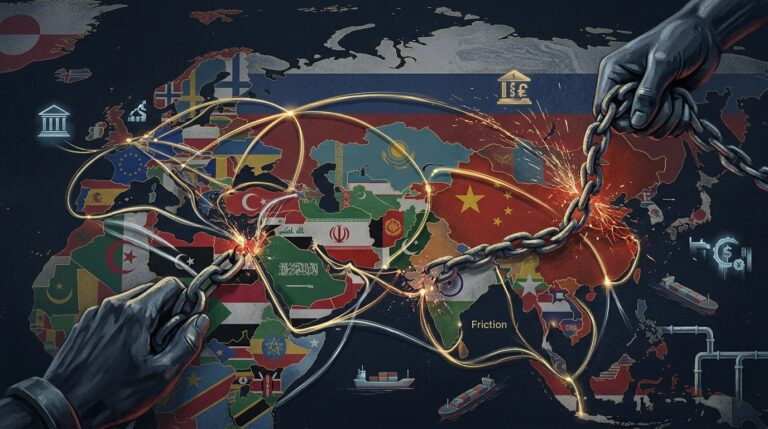
Eurasian supply chains are not escaping financial fragmentation so much as learning to operate inside it. As Western regulators tighten secondary sanctions pressure on cross-border payment networks, corporate treasuries and trade-finance institutions face a harder choice between conventional correspondent banking and alternative clearing channels that may be slower, less transparent, or more difficult to scale.
The policy debate is often framed as a binary contest: either Western clearing systems retain dominance, or local-currency settlement and alternative rails create a durable workaround. The more practical outcome is an efficiency penalty. Alternative payment routes can keep some trade moving, but they do not remove compliance risk, bank de-risking, working-capital pressure, or uncertainty over payment finality.
Sanctions Pressure Moves Through Banks
The enforcement perimeter is tightening around financial intermediaries that facilitate trade linked to sanctioned activity. The U.S. Department of the Treasury has described OFAC enforcement actions targeting financial networks connected to Russia’s defense-industrial base under Executive Orders 14024 and 14114.
European restrictions add another layer by limiting financial messaging channels. The European Commission’s EU financial restrictions include measures covering connection to, and transactions with, the Bank of Russia’s System for Transfer of Financial Messages, known as SPFS.
Together, these measures create incentives for Tier-1 commercial banks in non-sanctioned partner countries to scrutinize Eurasian trade payments more aggressively. Even where a transaction is not denominated in dollars, a bank that relies on access to Western markets may still delay, reject, or reroute activity that appears exposed to sanctions risk. That shifts some flows toward smaller regional institutions, where liquidity, compliance capacity, and settlement reliability may be weaker.
The Working-Capital Cost
The pressure is visible less as a single market break than as a series of frictions across the trade-finance chain. The Bank of Russia’s balance-of-payments statistics provide the relevant official framework for tracking external-sector pressures, including foreign financial assets and trade-credit dynamics. They do not, by themselves, identify every delayed payment or intermediary route, so conclusions about trapped receivables should be read as an indicator-based assessment rather than a complete transaction map.
For exporters, the operational problem is straightforward: if funds cannot be repatriated smoothly because intermediary banks slow or decline settlement, liquidity remains outside normal treasury channels. That lengthens working-capital cycles and can force companies to bridge domestic costs with short-term financing. For treasurers weighing alternatives, the question raised in Can Alternative Payment Rails Bypass Secondary Sanctions? is not only whether a payment can move, but whether it can move predictably, legally, and at commercial scale.
Where Friction Enters The Trade-Finance Chain
The current sanctions architecture creates several distinct points of stress:
- Messaging disruption: Restrictions involving SPFS reduce the usefulness of a Russian financial messaging alternative and push institutions toward less standardized channels.
- Bank de-risking: OFAC actions aimed at financial networks increase the perceived cost of handling sensitive flows, especially for banks that depend on Western correspondent relationships.
- Intermediary capacity: When business shifts from Tier-1 banks to smaller Tier-2 institutions, settlement can become less reliable because those institutions may have more limited balance-sheet and compliance capacity.
- Payment finality risk: Delayed or rerouted receivables create uncertainty over when exporters can treat funds as settled, reinforcing the concerns discussed in Trade Finance Settlement Risk: Secondary Sanctions and Payment Finality.
These are separate from currency denomination. A transaction invoiced in a local currency can still encounter sanctions screening, messaging limits, and counterparty-bank risk.
Alternative Infrastructure Is Not Immunity
Central banks are also testing new settlement architecture. The Bank for International Settlements describes the operational architecture and cross-border payment milestones of Project mBridge, a multi-CBDC platform relevant to future cross-border payments.
The significance of mBridge is technical and strategic, not immediate proof of sanctions insulation. Direct central bank digital currency exchange may reduce dependence on conventional correspondent banking in some settings, but commercial participants still face legal, compliance, and counterparty constraints. A platform can change the rail; it does not automatically remove the sanctions risk attached to the underlying trade, institution, or beneficiary.
What To Watch Next
The main uncertainty is scale. Public data do not show precisely how much Eurasian trade is clearing through smaller non-sanctioned banks, how often payments are delayed, or how much liquidity is stranded in intermediary jurisdictions. That opacity is itself part of the cost: less transparent settlement makes credit assessment, cash forecasting, and compliance review harder.
The next useful signal is the Bank of Russia’s external-sector data, especially trade credits and advances. Continued pressure in those line items would strengthen the case that payment friction and delayed settlement remain material. Another watchpoint is whether the U.S. Treasury announces additional OFAC actions involving third-country financial intermediaries. Such measures would indicate that secondary sanctions enforcement is moving further into the banking channels that keep Eurasian trade finance functioning. As Alternative Payment Rails Still Face Secondary Sanctions Risk notes, alternative infrastructure can reduce dependence on one channel without eliminating exposure to enforcement.
***
*Disclaimer: This article is for informational purposes only and does not constitute financial, legal, or tax advice. This article was researched and drafted with AI assistance. Market conditions and sanctions regulations change rapidly. Readers should consult licensed professionals before making corporate treasury or investment decisions based on geopolitical developments.*
Want the full institutional-style PDF version? Enter your email for the free PDF.