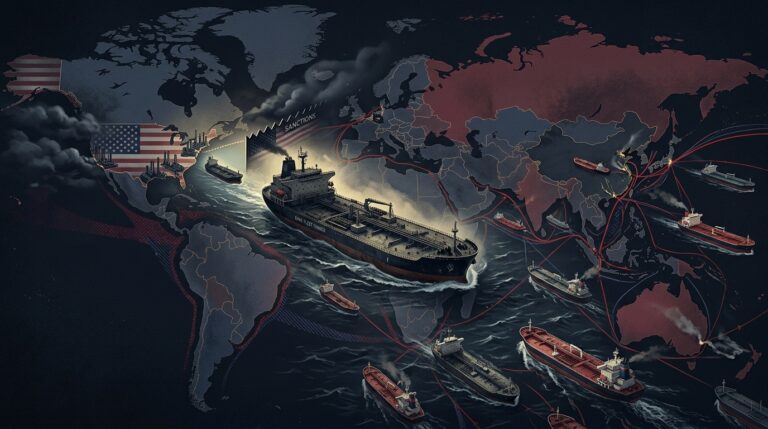
The Limits of Tanker Sanctions Relief
On October 19, 2026, U.S. Energy Secretary Chris Wright announced a new regulatory pathway to rehabilitate sanctioned “dark fleet” tankers. Speaking at a Citadel Securities event in New York, Wright outlined a framework allowing third-party investors to purchase and return these vessels to lawful crude trade without granting blanket sanctions relief (gCaptain).
While the policy aims to ease the maritime tanker squeeze, the actual impact on global energy freight rates will likely be negligible. Rigorous commercial filters eliminate the vast majority of the sanctioned fleet, and the current regional charter rate spike is driven primarily by war-risk insurance surcharges rather than a raw shortage of hulls.
OFAC’s Proposed Divestment Framework
The Treasury Department’s Office of Foreign Assets Control (OFAC) is developing a case-by-case authorization mechanism for these vessels. Rather than a general amnesty, prospective buyers must navigate strict regulatory hurdles.
Purchasers will be required to obtain formal approvals, prove bona fide divestment from sanctioned entities, and establish verifiable, legitimate ownership structures (Safety4Sea). This deliberate, vessel-by-vessel review process means any capacity injection will be gradual, preventing a sudden influx of tonnage into the legitimate market.
The Quantitative Filter: From 160 to 24 Hulls
The most significant barrier to freight rate relief is the physical and commercial state of the shadow fleet itself. When applying standard industry vetting criteria, the pool of viable candidates shrinks drastically.
According to shipping intelligence provider Kpler, there are approximately 160 OFAC-sanctioned Very Large Crude Carriers (VLCCs) currently operating. However, age and ownership restrictions filter out most of these vessels (Kpler):
- Total Sanctioned VLCCs: ~160 vessels
- Age Filter: Only 46 vessels (27 percent) fall under the 20-year commercial viability threshold required by most major charterers.
- Ownership Filter: Subtracting vessels owned by the National Iranian Tanker Company (NITC)—which face insurmountable political and legal hurdles for Western rehabilitation—reduces the commercially employable pool to approximately 24 hulls.
Reintegrating just two dozen VLCCs into the global fleet is insufficient to alter macroeconomic freight benchmarks. Furthermore, shifting a vessel from the shadow trade to the legitimate market does not create net new global capacity; it merely transfers the hull from one trade route to another.
War-Risk Premiums Over Hull Availability
Even if the 24 viable VLCCs clear OFAC vetting and secure Western classification, their return does not address the primary driver of elevated freight costs. The current squeeze in Persian Gulf transit rates is rooted in geopolitical risk, not a structural deficit of ships.
Charterers are paying elevated rates to cover surging war-risk insurance premiums for vessels navigating conflict-adjacent chokepoints. Adding a small fraction of rehabilitated tonnage to the legitimate market does not lower the insurance costs required to transit these high-risk zones.
Regulatory and Commercial Watchpoints
The timeline for this policy to affect physical markets remains highly uncertain. The framework is still in the executive proposal stage, and the speed of OFAC’s case-by-case reviews is unknown. Additionally, vessels transitioning out of the shadow fleet will likely require extensive drydocking and maintenance to meet international classification standards, delaying their commercial availability.
Market participants should monitor the Treasury Department for the publication of formal OFAC vetting guidelines. The next concrete indicator of the program’s viability will be the first successful sale-and-purchase (S&P) transaction and subsequent classification society certification of a formerly sanctioned VLCC under this new framework.
Disclaimer: This article is for informational purposes only and does not constitute financial, legal, or investment advice. This article was researched and drafted with AI assistance. Geopolitical events and regulatory frameworks are subject to rapid change. Readers should consult licensed professionals before making maritime or investment decisions.
Want the full institutional-style PDF version? Enter your email for the free PDF.